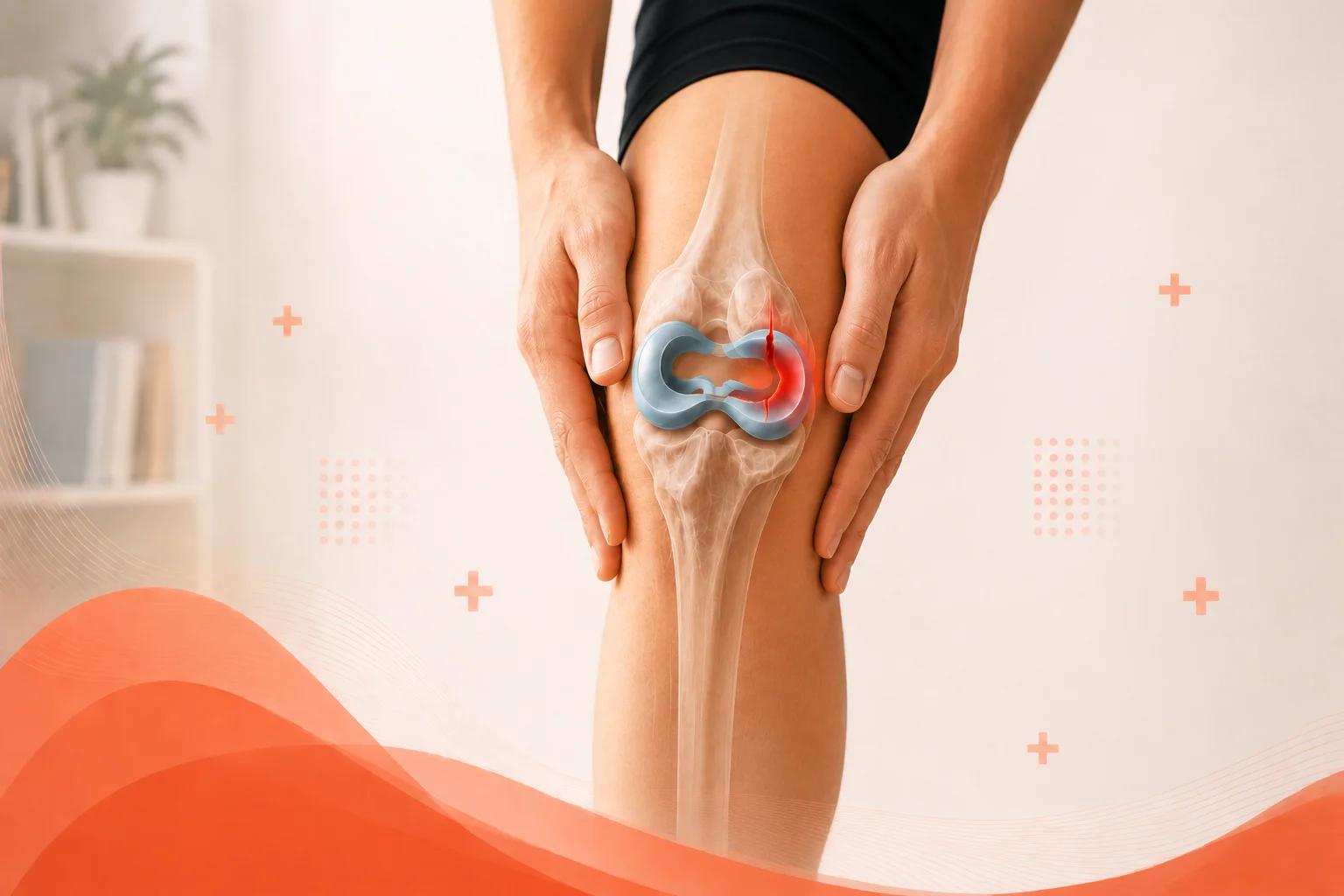
The meniscus is the cartilage cushion in your knee that absorbs shock when you walk, run, or squat. When it tears, the most common question patients ask Dr. R.P. Singh at Medinity Hospital, Lucknow is: do I really need surgery, or can physiotherapy fix this? The honest answer is: it depends on the type of tear, your age, and what you want to do with your knee.
The good news first: many meniscus tears do not require surgery. A landmark 2013 study published in the New England Journal of Medicine found that for degenerative meniscus tears, physiotherapy produced outcomes equivalent to arthroscopic surgery at six months and beyond. But this finding applies only to certain types of tears. For others, surgery is clearly the better choice. The key is knowing which category you are in.
What is a meniscus tear and how does it happen?
Your knee has two menisci: a C-shaped disc of fibrocartilage on the inner side (medial meniscus) and one on the outer side (lateral meniscus). Together, they act as shock absorbers, distribute load evenly across the knee joint, and help maintain stability during movement.
Meniscus tears fall into two broad categories:
- Acute tears: happen suddenly during a specific incident, usually a twisting or squatting movement. Common in gym goers doing deep squats or lunges, and in athletes who pivot hard. The tear occurs in otherwise healthy cartilage.
- Degenerative tears: develop gradually over time due to age related wear of the meniscus tissue. Most common in patients over 40. The cartilage becomes thinner and more brittle, and a minor movement, or sometimes no specific injury at all, can cause a tear.
The most common symptoms include a clicking or locking sensation when bending the knee, swelling that appears within 24 to 48 hours of injury, pain along the inner or outer edge of the knee, and difficulty fully straightening or bending the knee. If you recognise these as meniscus injury warning signs, early assessment prevents the tear from worsening.
Types of meniscus tears: does the type affect your treatment?
Yes, significantly. The most important factor is where the tear sits within the meniscus, specifically how much blood supply that area receives. The meniscus has three zones, each with different healing potential:
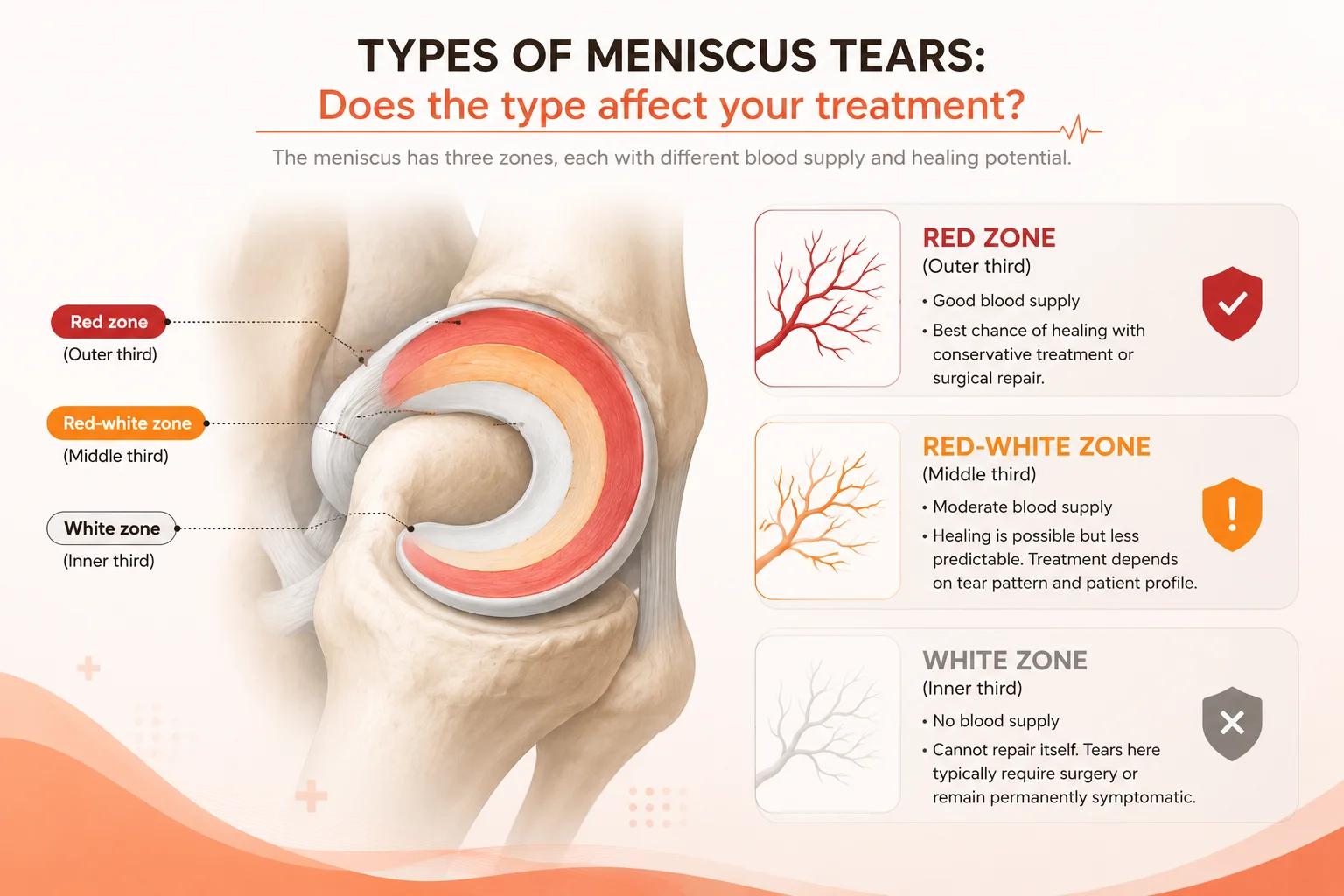
Red zone (outer third)
Good blood supply
Best chance of healing with conservative treatment or surgical repair.
Red-white zone (middle third)
Moderate blood supply
Healing is possible but less predictable. Treatment depends on tear pattern and patient profile.
White zone (inner third)
No blood supply
Cannot repair itself. Tears here typically require surgery or remain permanently symptomatic.
In addition to zone, the shape of the tear matters:
When physiotherapy alone is enough for a meniscus tear
Not every torn meniscus needs an operation. Physiotherapy is genuinely effective and should be the first treatment tried in the following situations:
You are a good candidate for physiotherapy if:
- The tear is in the outer red zone of the meniscus (good blood supply)
- You are over 40 and the tear is degenerative rather than from a sudden injury
- The knee does not lock when you bend or straighten it
- You can walk without the knee giving way
- You are less active and do not need to return to high impact sport
- Your MRI shows a small, stable partial thickness tear
At Medinity Hospital's physiotherapy and rehabilitation at Medinity department in Gomti Nagar, Lucknow, a structured rehabilitation programme for a meniscus tear typically runs over 8 to 12 weeks and includes quadriceps and hamstring strengthening, balance and proprioception training, and a gradual return to the activities that matter to you.
When surgery becomes the better option for meniscus tear treatment Lucknow
There are specific situations where physiotherapy is unlikely to resolve the problem and arthroscopic surgery gives a significantly better outcome:
Surgery is the better choice when:
- The knee is locking, meaning it gets mechanically stuck and cannot be straightened
- The tear is a bucket handle type with a displaced fragment inside the joint
- The tear is in the inner white zone with no blood supply (cannot self heal)
- You are a young, active patient who wants to return to sport involving twisting or pivoting
- Physiotherapy has been tried for 3 months without meaningful improvement
- The MRI shows a complex or full thickness tear with instability
Arthroscopic meniscus surgery at Medinity Hospital is performed through two small incisions, each less than a centimetre. Dr. R.P. Singh uses a small camera and instruments inside the joint to either repair the torn meniscus with sutures (for repairable tears in the red zone) or trim away only the damaged portion (meniscectomy) when repair is not possible.
The principle guiding Dr. R.P. Singh's approach is preservation wherever possible. Removing less meniscal tissue preserves the shock absorbing function of the knee and significantly reduces the long term risk of knee arthritis. Research published in the NIH literature shows that more than 75% of patients with symptomatic osteoarthritis have a history of meniscal injury, which is why how the surgery is done matters as much as whether surgery is done. For related knee injuries, see our guides on ACL tears and knee ligament tears.
What does recovery look like after meniscus treatment?
Recovery timelines differ depending on whether you had physiotherapy or surgery, and within surgery, whether the meniscus was repaired or trimmed.
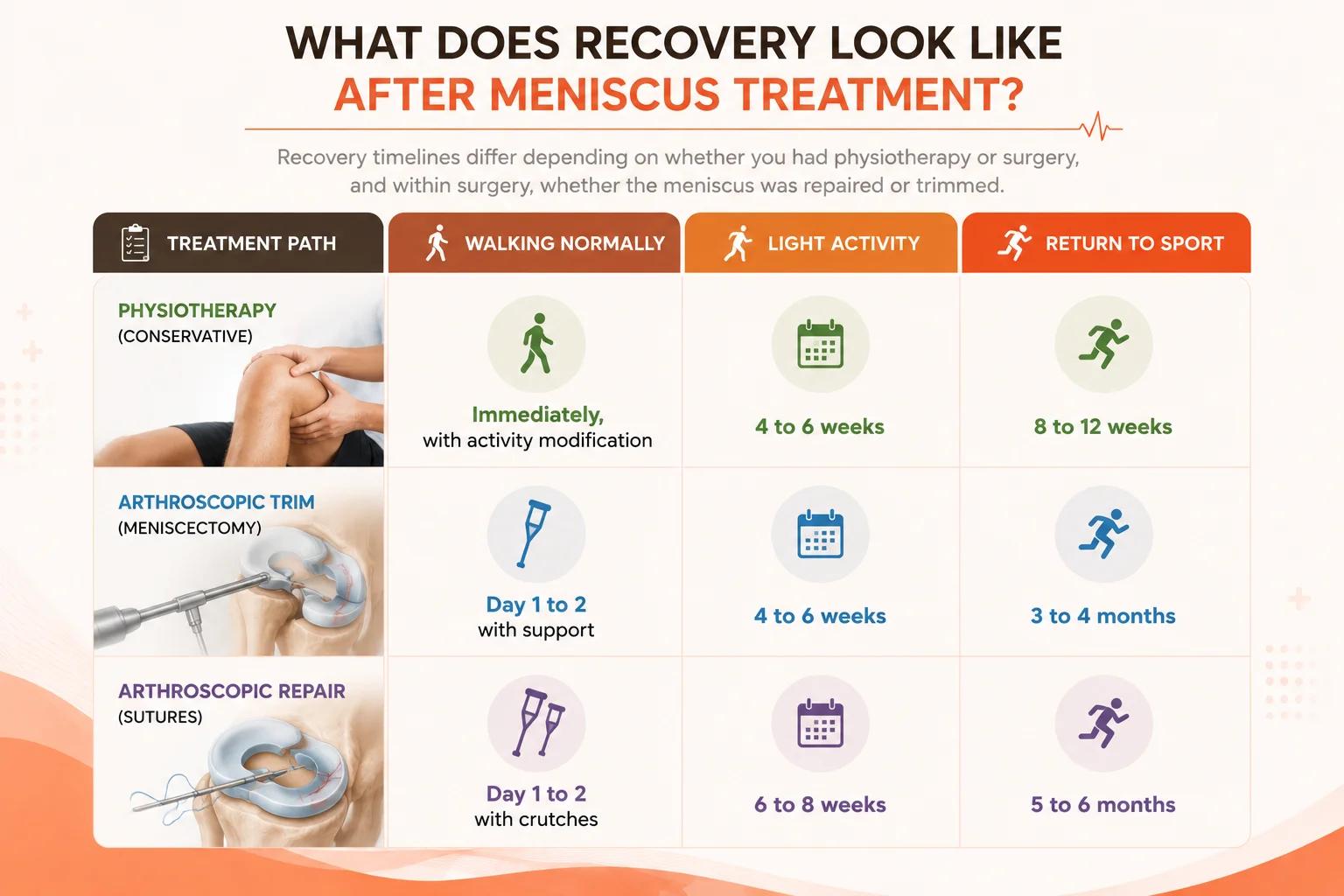
Recovery is faster after a trim than after a repair because a repair requires the tissue to fully heal, which takes longer. However, a repair preserves more of the meniscus and gives better long term outcomes. The right choice between repair and trim depends on what Dr. R.P. Singh finds during arthroscopy.
How Dr. R.P. Singh decides: the Medinity approach
When you come to Medinity Hospital with a suspected meniscus injury, the decision making process follows a clear, evidence based pathway.
Clinical examination
Dr. R.P. Singh uses the McMurray test, Thessaly test, and joint line tenderness assessment to identify the likely site and type of tear from physical examination alone.
MRI review
A high quality MRI confirms the tear type, its location within the meniscal zones, and any associated damage to the ACL, cartilage, or other structures.
Shared decision making
The treatment recommendation is explained clearly, including the evidence behind it. Dr. R.P. Singh's decision is never based on surgical preference. It is based on what the MRI shows, your age, your activity level, and what outcome matters most to you.
Surgery only when justified
Patients whose MRI shows a degenerative tear with no locking and no instability will be recommended physiotherapy first. Surgery is discussed only if physiotherapy does not resolve the problem after a structured trial.
Dr. R.P. Singh holds MS Ortho with a Gold Medal and completed fellowship training in joint reconstruction in both the United States and Germany. He has performed over 2,000 orthopaedic surgeries at Medinity Hospital, Gomti Nagar, and has a 4.8-star rating from 246+ verified patient reviews. Patients come to Medinity from Lucknow, Kanpur, Sitapur, Hardoi, Barabanki, and across Uttar Pradesh for both surgical and non surgical orthopaedic care. Athletes and active patients are also seen by our sports injury specialist in Lucknow team.
Quick guide: physiotherapy or surgery for your meniscus tear?
This table is a general guide, not a diagnosis. Only an MRI and a clinical assessment by Dr. R.P. Singh will determine the right treatment for your specific tear. If your knee is locking or you cannot walk properly, do not wait. Call +91 94540 99331 or visit Medinity Hospital, Gomti Nagar, Lucknow.
Help centre
Frequently asked questions
Healing without surgery, recovery after arthroscopy, and when to seek care promptly.
Yes, some meniscus tears can heal with physiotherapy, particularly small tears in the outer red zone which has a good blood supply. Degenerative tears in patients over 40 who are not involved in high impact sport also often respond well to conservative treatment. However, tears that cause the knee to lock, or tears in the inner white zone which has no blood supply, usually require surgical repair. Dr. R.P. Singh at Medinity Hospital, Lucknow, will review your MRI and advise the best approach for your specific tear.
Most patients can walk with support within one to two days of arthroscopic meniscus surgery. Return to light daily activity takes 4 to 6 weeks. Return to sport takes approximately 3 to 6 months depending on whether the meniscus was trimmed or repaired, and how consistently you follow the rehabilitation programme at Medinity Hospital.
Arthroscopic keyhole meniscus surgery is performed under anaesthesia, so you feel nothing during the procedure. Post-operative pain is managed with medication and is typically well controlled. Most patients at Medinity Hospital find that the discomfort after surgery is more manageable than the pain they were experiencing from the tear itself, particularly if the knee was locking beforehand.
Arthroscopic meniscus surgery at Medinity Hospital is typically done as a one night admission. Most patients go home the day after surgery. Because the procedure uses keyhole technique with two small incisions rather than an open operation, recovery begins quickly and the wound heals faster.
Yes. A meniscus tear that is ignored and not treated, especially if you continue high impact activity on the injured knee, can worsen over time. A small, repairable tear can extend into a bucket handle tear. Continued loading on an unstable knee accelerates cartilage wear. Research shows that over 75% of patients with knee osteoarthritis have a history of meniscal injury. Early assessment and treatment prevents this progression.
Until you have been assessed by an orthopaedic specialist, avoid deep squats below 90 degrees, full knee bends, running on hard surfaces, and any pivoting or twisting movements. These load the meniscus unevenly and can extend a partial tear into a complete one. Walking on flat ground is generally safe. If your knee is locking, stop activity and see a doctor promptly.
Gentle walking may be beneficial during recovery, but excessive walking can worsen symptoms. The right amount depends on the severity and location of the tear.
Persistent swelling, knee locking, inability to straighten the knee, and ongoing pain are signs that the tear may require specialist evaluation.
Untreated tears can lead to persistent pain, recurrent swelling, knee instability, and accelerated cartilage damage over time.
Yes. Certain tear patterns can cause a piece of the meniscus to become trapped inside the joint, resulting in locking or restricted movement.
The cost depends on the procedure performed, hospital stay, implants (if required), and individual patient factors. A consultation and MRI evaluation help determine the most appropriate treatment plan.
About the author
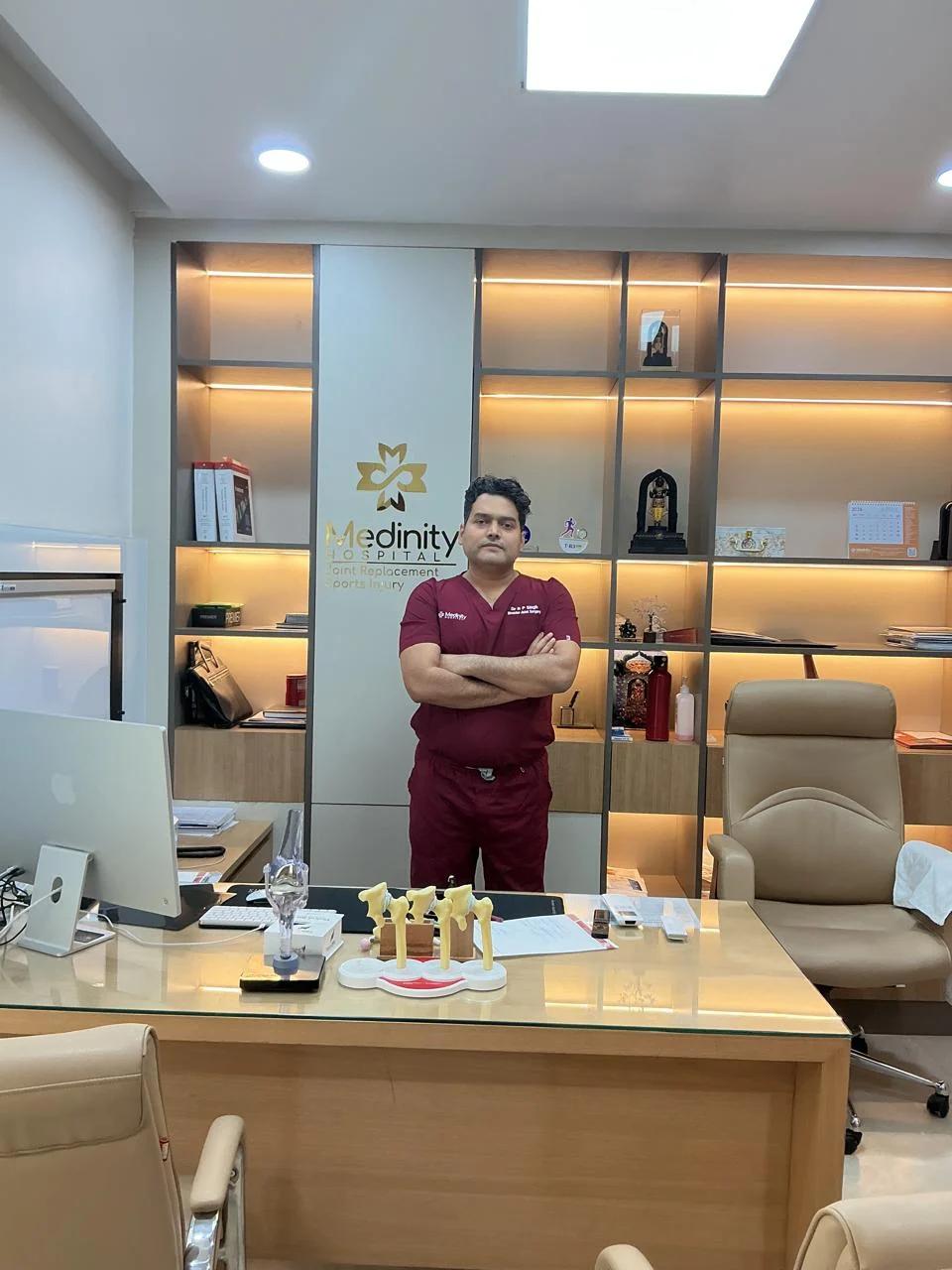
Dr. R.P. Singh
MS Ortho (Gold Medalist) · Fellowship Joint Reconstruction (USA, Germany) · Senior Orthopaedic Surgeon
- 20+ years experience
- 2,000+ surgeries
- Meniscus repair & arthroscopy
Dr. R.P. Singh leads orthopaedics at Medinity Hospital, Gomti Nagar, with expertise in arthroscopic meniscus surgery, cartilage preservation, and evidence based conservative care for knee injuries across Uttar Pradesh.
View full profile & credentialsConsultation
Book a consultation at Medinity Hospital, Lucknow
If your knee is clicking, locking, or has not improved after rest, book a consultation. Dr. R.P. Singh will review your MRI, explain whether physiotherapy or arthroscopic surgery is right for your tear, and outline a recovery plan matched to your goals.
- Structured physiotherapy and post surgical rehab under one roof in Gomti Nagar
- Walk-in OPD and 24/7 emergency orthopaedic support
CP-221, Hahnemann Medinity Hospital Road, Gomti Nagar, Lucknow 226010 · Walk-in OPD · 24/7 emergency