Medinity Hospital — Best Multispeciality Hospital in Lucknow
Book Appointment with Dr. R.P. Singh

7 sports injuries you should never ignore (and what to do)

Ignoring a sports injury in Lucknow? Dr. R.P. Singh explains 7 injuries that get worse without treatment and when to see a sports injury doctor.

6 min readByDr. R.P. Singh·Orthopaedics

Sports injury assessment

Mobile number
Share this article

Most sports injuries feel like 'just a sprain' at first. The problem is that some sprains are actually fractures. Some fractures involve damaged nerves. And what feels like a minor knee twist could be a ligament tear that gets significantly worse if you train through it.

Dr. R.P. Singh, Senior Orthopaedic Surgeon at Medinity Hospital, Lucknow, explains the 7 injuries that patients most commonly downplay and why early treatment makes a major difference.

Quick overview: 7 injuries at a glance

Here is a quick overview before we go through each one in detail:

Injury
Most common in
Red flag sign
See a doctor within
ACL or PCL tear
Cricketers, kabaddi, gym athletes
Knee giving way when you walk
48 hours
Stress fracture
Runners, army, kabaddi players
Pain during activity, gone at rest
1 week
Meniscus tear
Gym-goers, squatters
Knee clicking or locking when bending
1 week
Shoulder dislocation
Kabaddi, wrestling, contact sports
Shoulder looks visibly out of place
Same day
Ankle ligament injury
All sports
Repeated spraining of same ankle
72 hours
Hamstring or quad tear
Sprinters, footballers
Pop in back of thigh during sprint
48 hours
Growth plate injury
Children aged 10 to 16 playing sport
Joint-area pain after activity in a child
Within 1 week
01

ACL and PCL tears

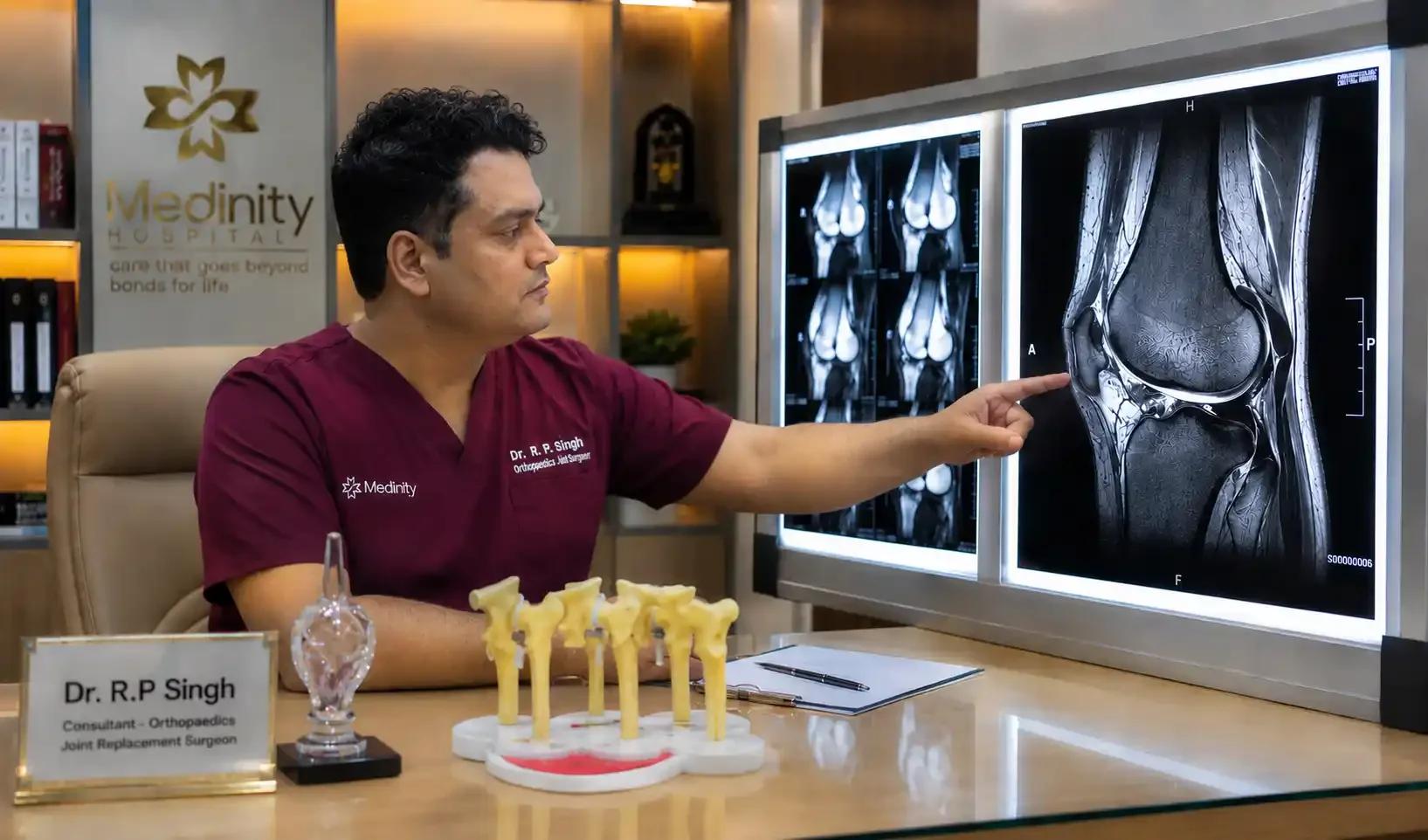
Dr. R.P. Singh reviewing MRI scan for sports injury diagnosis at Medinity Hospital Lucknow
Early MRI review helps confirm ACL and PCL tears before cartilage damage worsens.

Why patients ignore it

Many patients can walk after an ACL or PCL tear, so they assume the knee is fine. They come back to training within a week.

Why you should not

The ACL has no blood supply. It cannot repair itself. Every session you train on an unstable knee, the cartilage inside absorbs force the ligament should be taking. Within weeks, meniscus damage begins. Within months, cartilage wears. Within years, you have early onset arthritis that could have been avoided.

What to do

Stop training immediately. Apply ice, keep the leg elevated, and book an MRI. Do not wait for the swelling to go down and assume you are fine. See a sports injury doctor in Lucknow within 48 hours of the injury. For sport specific guidance, read our guides on ACL tear symptoms and treatment and knee ligament tear symptoms.
Roughly 50% of ACL tears occur alongside other structures: the meniscus, cartilage, or the MCL. This is known in orthopaedic medicine as the 'unhappy triad', and it only happens when patients continue loading an already torn knee. Early diagnosis prevents it.
02

Stress fractures

Why patients ignore it

Pain builds gradually. It gets better with rest, so athletes think it is just muscle soreness. They continue training and take painkillers.

Why you should not

A stress fracture is a hairline crack in the bone from repetitive overload. X-rays miss up to 60% of stress fractures in the early stages because the crack is too small to show up. MRI is required for an accurate diagnosis. If you run through a stress fracture, the hairline crack can become a complete break. In the shin bone, this can require surgery. In the foot, it can mean months off sport instead of weeks.

What to do

Watch for pain that gets worse during exercise but eases completely with rest. This is the defining pattern. If pain is localised to one specific point on a bone and is tender to press, get an MRI. Runners in Lucknow who train on hard roads should pay particular attention to shin and foot pain.
Stress fractures are especially common in army personnel and kabaddi players in Uttar Pradesh due to high impact, repetitive loading on hard ground. If you are in this category and have point tenderness over a bone, do not dismiss it as muscle fatigue.
03

Meniscus tears

Why patients ignore it

The knee clicks or locks when bending, but it goes away. Athletes assume it is just 'tight' and stretch more. Many gym goers in Lucknow continue squats and lunges through a meniscus tear for weeks.

Why you should not

A small meniscus tear that is caught early can often be repaired with a short arthroscopic procedure and a 3 to 4 month recovery. If you continue loading it, the tear extends. A bucket handle tear that could have been repaired with a simple stitch now requires removal of part of the meniscus. Less meniscus means more cartilage wear and a significantly higher chance of knee arthritis within 10 years.

What to do

The classic sign is a clicking or locking sensation when you fully bend or straighten the knee. Swelling that comes and goes after activity is also common. Book an MRI. The earlier a meniscus tear is found, the more likely it can be repaired rather than removed.
04

Shoulder dislocation

Why patients ignore it

The shoulder goes back in on its own or is relocated by a friend, and the pain settles. Many kabaddi and wrestling players go back to training after a few days.

Why you should not

When the shoulder dislocates, it tears the labrum, which is the cartilage rim that keeps the shoulder joint in its socket. Without treatment, the labrum does not heal properly, and the shoulder becomes prone to repeated dislocations. Each dislocation causes more damage. After three or more dislocations, the bone itself begins to erode. Surgery that was simple early on becomes a bone grafting procedure later.

What to do

After any shoulder dislocation, see an orthopaedic specialist before returning to sport. An MRI will confirm whether the labrum is torn. If it is, a small arthroscopic procedure (Bankart repair) prevents future dislocations and protects the joint long term.

Patient story

I was suffering from a dislocated shoulder for a long time. Dr. R.P. Singh solved my problem with a small operation.

Nagendra Singh

Verified patient · Medinity Hospital

Verified
05

Ankle ligament injuries

Why patients ignore it

The most undertreated sports injury in India. An ankle sprain heals in a few days and athletes return to training. When it happens again, they assume it is just a 'weak ankle'.

Why you should not

Each ankle sprain that is not rehabilitated properly leaves the ligaments slightly looser than before. Over time, this creates chronic ankle instability. The ankle gives way during ordinary walking, not just during sport. Eventually, cartilage inside the ankle joint begins to wear, leading to ankle arthritis that is very difficult to reverse.

What to do

After an ankle sprain, rest is not enough. A structured physiotherapy programme that strengthens the peroneal muscles and restores proprioception is essential before you return to sport. If the same ankle has sprained two or more times, get an MRI to check whether the ligaments are partially torn.
06

Hamstring and quadriceps tears

Why patients ignore it

A sharp pain in the back of the thigh during a sprint that settles to a dull ache. Many footballers and sprinters in Lucknow take a few days off and go back to training.

Why you should not

Muscle tears are graded 1 to 3. A Grade 1 strain involves micro tears and heals in 2 to 3 weeks with rest. A Grade 3 is a complete tear that sometimes requires surgery and 3 to 4 months of rehabilitation. Returning to sprinting too early on a Grade 2 tear frequently causes a more severe Grade 3 tear at the same site, often on the first hard sprint. Re injury at the same spot is almost always worse than the original injury.

What to do

After a pop or sharp pain in the thigh during a sprint, stop immediately. Do not try to 'run it off'. Use the RICE method for 48 hours, then get an ultrasound or MRI to grade the tear before deciding on your return timeline.
The key question with any muscle tear is: did you hear or feel a pop during the injury? A pop during a sprint or a jump is a signal of a Grade 2 or Grade 3 tear. A gradual ache that built up over time is more likely a Grade 1 strain or a tendinopathy. The difference matters significantly for the return timeline.
07

Growth plate injuries in young athletes
Why patients ignore it

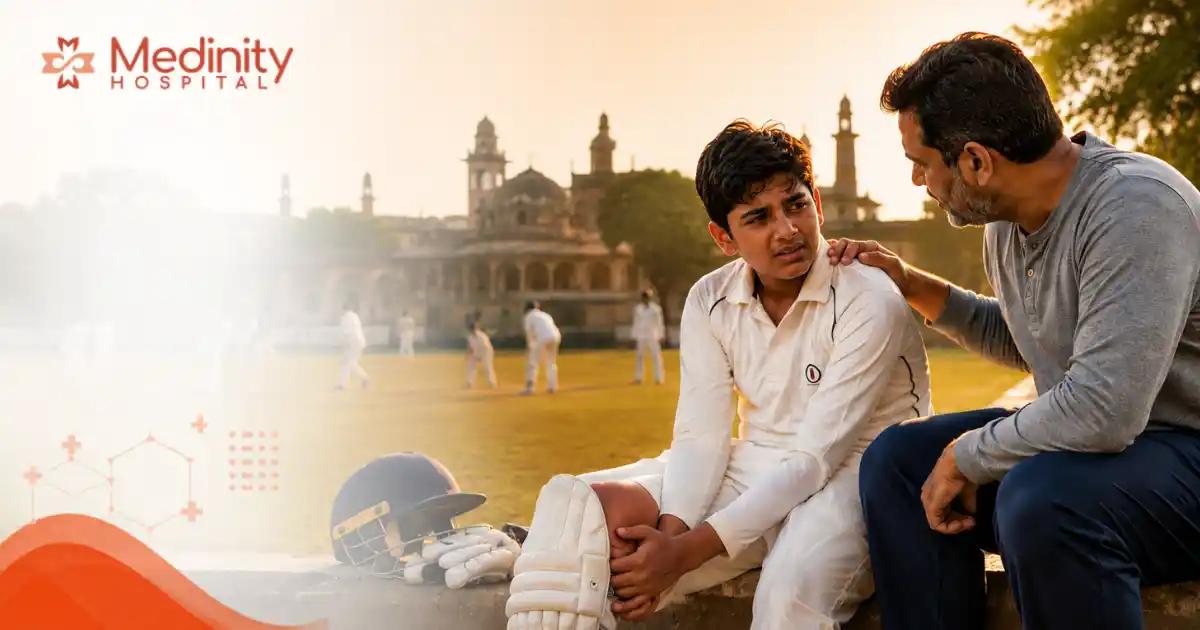
Parents and coaches assume joint pain in children is growing pain or minor soreness. The child continues training or is pushed through practice.

Why you should not

Children's bones contain growth plates, which are areas of developing cartilage near the ends of long bones. A growth plate is two to five times weaker than the surrounding ligaments. In an adult, a sharp twist might tear a ligament. In a child aged 10 to 16, the same force can fracture the growth plate instead. An untreated growth plate fracture can cause the bone to stop growing or grow unevenly, leading to one leg longer than the other or permanent joint deformity. These consequences are entirely preventable with early diagnosis.

What to do

Any persistent joint pain in a child who plays sport, especially pain that appears during or after activity and is localised near a joint, must be evaluated by an orthopaedic specialist. A plain X-ray will often show a growth plate injury, but MRI may be needed for subtle cases. Early treatment is almost always simple. Late treatment of a growth plate problem can be complex and permanent.

When to see a sports injury doctor in Lucknow

Dr. R.P. Singh is a Senior Orthopaedic Surgeon at Medinity Hospital, Gomti Nagar, Lucknow, with 20+ years of clinical experience and more than 2,000 orthopaedic surgeries performed. He holds MS Ortho with a Gold Medal and completed fellowship training in joint reconstruction from both the United States and Germany, which is uncommon among orthopaedic surgeons currently practising in Lucknow.

Whether you are a cricketer with a knee injury, a kabaddi player with a dislocated shoulder, a runner with shin pain, or a parent concerned about your child's joint pain after a school match, the right time to see a sports injury specialist in Lucknow is as early as possible. The injuries listed above are all significantly more straightforward to treat when they are caught at the right stage.
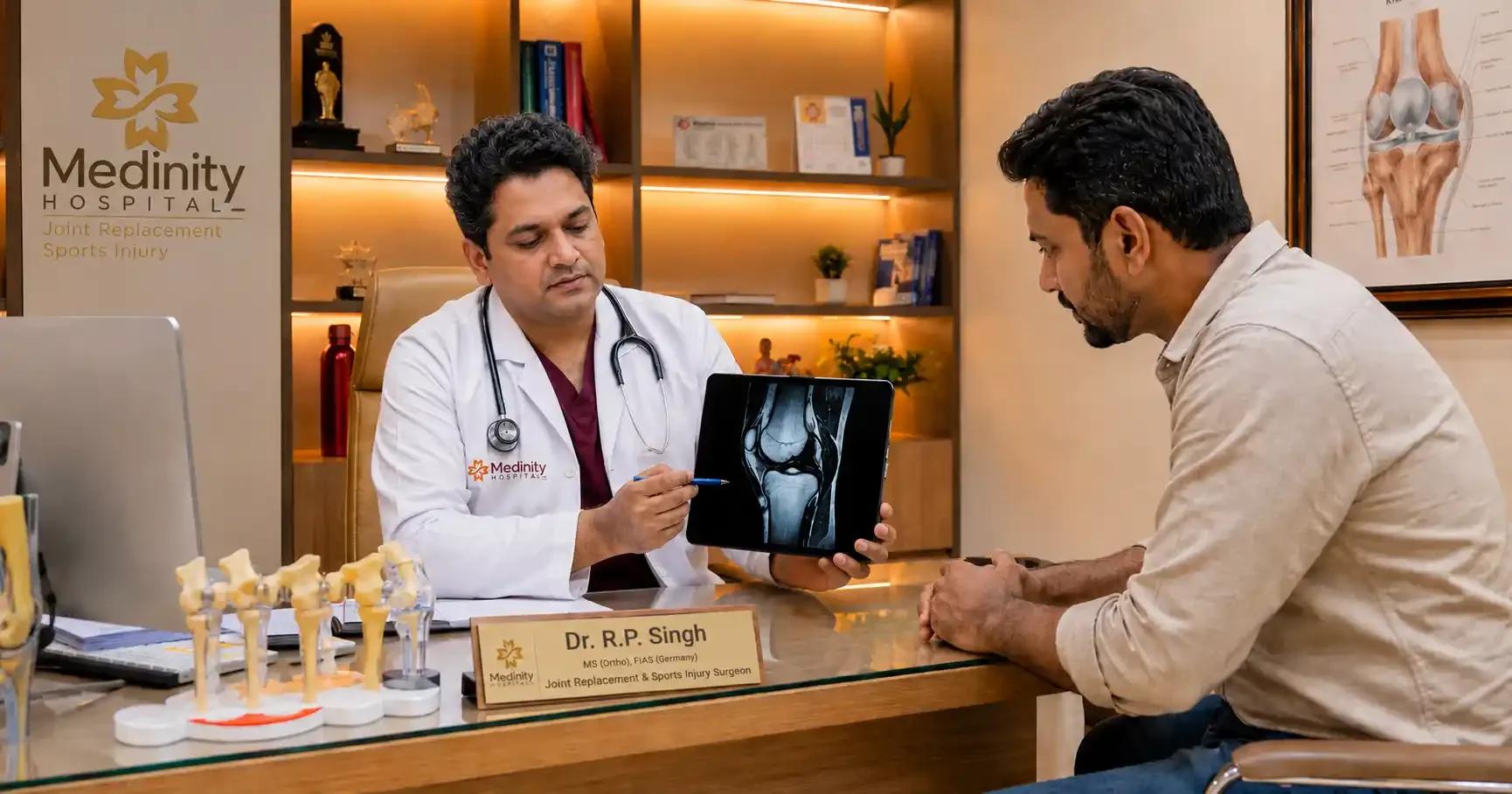
Dr. R.P. Singh consulting a patient for sports injury assessment at Medinity Hospital Lucknow
Book a sports injury assessment with Dr. R.P. Singh at Medinity Hospital, Gomti Nagar.
Dr. R.P. Singh, Senior Orthopaedic Surgeon at Medinity Hospital, Lucknow

About the author

Dr. R.P. Singh

MS Ortho (Gold Medalist) · Fellowship Joint Replacement (USA, Germany) · Senior Orthopaedic Surgeon

  • 20+ years experience
  • 2,000+ surgeries
  • Sports injury assessment

Dr. R.P. Singh leads orthopaedics at Medinity Hospital, Gomti Nagar, with expertise in sports injuries, arthroscopic surgery, and return to sport rehabilitation for patients across Uttar Pradesh.

View full profile & credentials

Use this guide to decide how urgently you need assessment:

A loud pop in the knee during sport
See a doctor within this time48 hours
Swelling that appeared within 2 hours of injury
See a doctor within this time48 hours
A shoulder that came out of its socket
See a doctor within this timeSame day
Knee clicking or locking when bending
See a doctor within this time1 week
Pain on a specific spot of bone that worsens during exercise
See a doctor within this time1 week
A pop in the back of the thigh during a sprint
See a doctor within this time48 hours
A child with joint pain after sport practice
See a doctor within this time1 week
An ankle that has sprained two or more times
See a doctor within this timeAs soon as possible

Medinity Hospital provides 24/7 emergency care at Medinity Hospital and NABH-accredited surgical facilities at Gomti Nagar, Lucknow. Patients travel from Sitapur, Hardoi, Barabanki, Kanpur, and across Uttar Pradesh for sports injury treatment at Medinity Hospital and care through our orthopaedics department. The hospital has a 4.8-star rating from 246+ verified patient reviews on Google.

Help centre

Frequently asked questions

When to seek emergency care, who to see, and how Medinity treats young athletes.

  • Go immediately if you hear a loud pop and cannot walk at all, if there is obvious deformity of the joint or bone, severe swelling that appeared within 30 to 60 minutes, numbness or tingling anywhere in the leg or arm, or if the injury involved the head or spine. Medinity Hospital has 24/7 emergency orthopaedic care at our Gomti Nagar facility. Call +91 94540 99331 for immediate assistance.

  • A general doctor can provide initial first aid, pain management, and basic X-rays. However, for accurate diagnosis of ligament tears, cartilage injuries, stress fractures, or growth plate damage, you need an orthopaedic specialist who understands sports biomechanics. Dr. R.P. Singh at Medinity Hospital specialises in sports injury assessment and treatment in Lucknow and will give you a diagnosis based on clinical examination and, where needed, MRI.

  • Five signs suggest a serious injury that needs prompt assessment: a popping sound at the moment of injury, swelling that appears within 2 hours, inability to put weight through the joint, a feeling of instability or giving way, and numbness or tingling. If you have any two of these signs after a sports injury, get assessed within 48 hours.

  • Minor Grade 1 strains and mild sprains often heal with rest, ice, compression, and elevation over 1 to 2 weeks. However, ligament tears, stress fractures, meniscus injuries, and growth plate damage do not heal reliably without professional assessment and a structured treatment plan. The risk of training through an undiagnosed injury is that a manageable problem becomes a complex one. When in doubt, get it checked.

  • Yes. Dr. R.P. Singh at Medinity Hospital, Gomti Nagar, assesses and treats sports injuries in young athletes, including growth plate injuries, fractures, and ligament problems. Parents from across Lucknow and surrounding districts bring their children to Medinity for orthopaedic evaluation. Call +91 94540 99331 to book an appointment.
Consultation

Book a consultation at Medinity Hospital, Lucknow

If you are experiencing a sports injury, do not wait. Dr. R.P. Singh, Senior Orthopaedic Surgeon at Medinity Hospital, Gomti Nagar, Lucknow, has 20+ years of experience and has performed over 2,000 orthopaedic surgeries. He is a Gold Medalist in MS Ortho with fellowship training in joint replacement from both the USA and Germany.

  • Walk-in OPD and 24/7 emergency orthopaedic support at Gomti Nagar
  • Sports injury assessment, MRI guidance, and structured return to sport planning

CP-221, Hahnemann Medinity Hospital Road, Gomti Nagar, Lucknow 226010 · Walk-in OPD · 24/7 emergency
Keep reading

More expert articles from Medinity specialists.

Knee ligament tear injury with support brace at Medinity Hospital Lucknow

Knee ligament tear: how to tell if yours is serious

Swollen knee after a fall or sport? Learn to identify knee ligament tear symptoms, grades, and when to see a doctor. Dr. R.P. Singh at Medinity Hospital, Lucknow.

May 11, 20265 min read
Dr. R.P. SinghRead article
ACL tear in cricketers — knee injury treatment at Medinity Hospital Lucknow

ACL tear in cricketers: symptoms, treatment and return to play

Felt a pop in your knee while playing cricket? Learn ACL tear signs, treatment options, and return-to-play guidance from Dr. R.P. Singh at Medinity Hospital, Lucknow.

May 5, 20268 min read
Dr. R.P. SinghRead article