
Quick answer: what is AVN of the hip and can it be treated without surgery?
Avascular necrosis (AVN) of the hip is the death of bone tissue in the femoral head caused by interrupted blood supply. It is staged 1 to 4 using the Ficat and Arlet classification (1980).
How is it treated?
- 1Stages 1 and 2: Can often be treated without full hip replacement using core decompression, which has a 70 to 80% success rate at preventing collapse (Hernigou et al. meta-analysis, JBJS).
- 2Stages 3 and 4: Where the femoral head has already collapsed, typically require total hip replacement, which achieves a 90 to 95% patient satisfaction rate.
- 3Primary causes: In India, the most common triggers are steroid use, alcohol consumption, and smoking.
If you have just been told you have AVN of the hip, the first reaction is usually confusion. Unlike arthritis, which most patients understand intuitively, avascular necrosis is harder to picture and harder to find accurate information about.
Dr. R.P. Singh, orthopaedic surgeon at Medinity Hospital, Gomti Nagar, Lucknow, is a specialist hip surgeon in Lucknow who diagnoses and treats AVN regularly. He sees patients from Indira Nagar, Aliganj, Jankipuram, Hazratganj, Alambagh, and from Sitapur, Hardoi, Barabanki, Raebareli, Kanpur, and Unnao. This article explains what AVN is, its symptoms, its stages, how fast it progresses, what it costs to treat in Lucknow, and what the treatment options are at each stage (you can also watch Dr. R.P. Singh's video explanation below).
What is AVN of the hip, explained without medical jargon
Your hip is a ball-and-socket joint. The ball, called the femoral head, sits at the top of the thigh bone. It needs a continuous blood supply to survive. Avascular necrosis means the death of bone tissue from lack of blood.
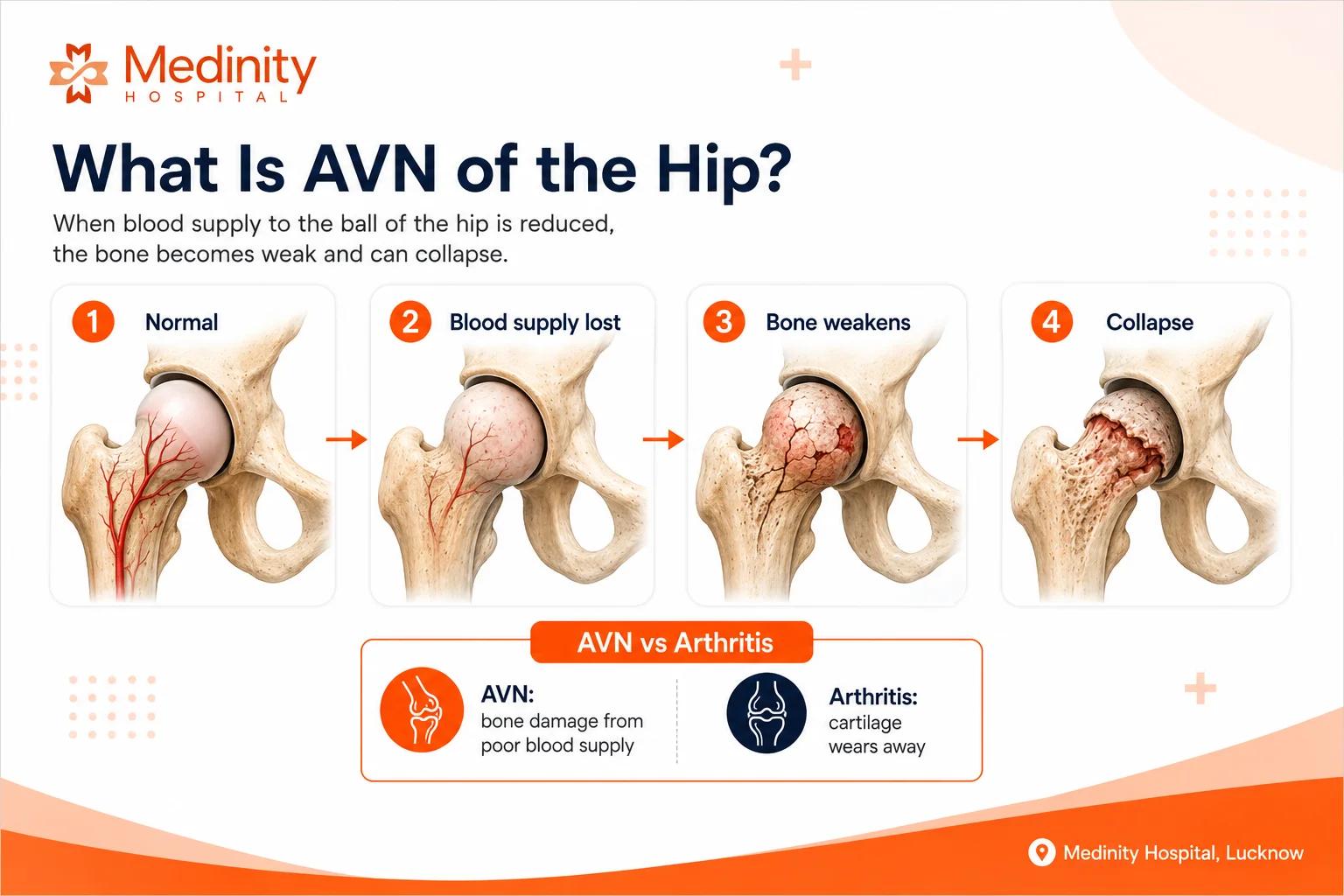
When blood vessels supplying the femoral head are blocked or damaged, bone cells inside begin to die. The weakened bone cannot support body weight. Over time, the ball cracks internally, then flattens, then collapses. Once collapse occurs, the hip joint no longer works properly and pain becomes severe and constant.
AVN versus arthritis
Arthritis is the wearing away of cartilage. AVN is the death of the bone underneath the cartilage, from a vascular cause. The distinction matters because treatment options and timelines differ significantly. Patients diagnosed with 'hip arthritis' should ask whether AVN has been specifically ruled out by MRI, particularly if they are under 60 or have risk factors like steroid use.
Symptoms of AVN of the hip: what to look for
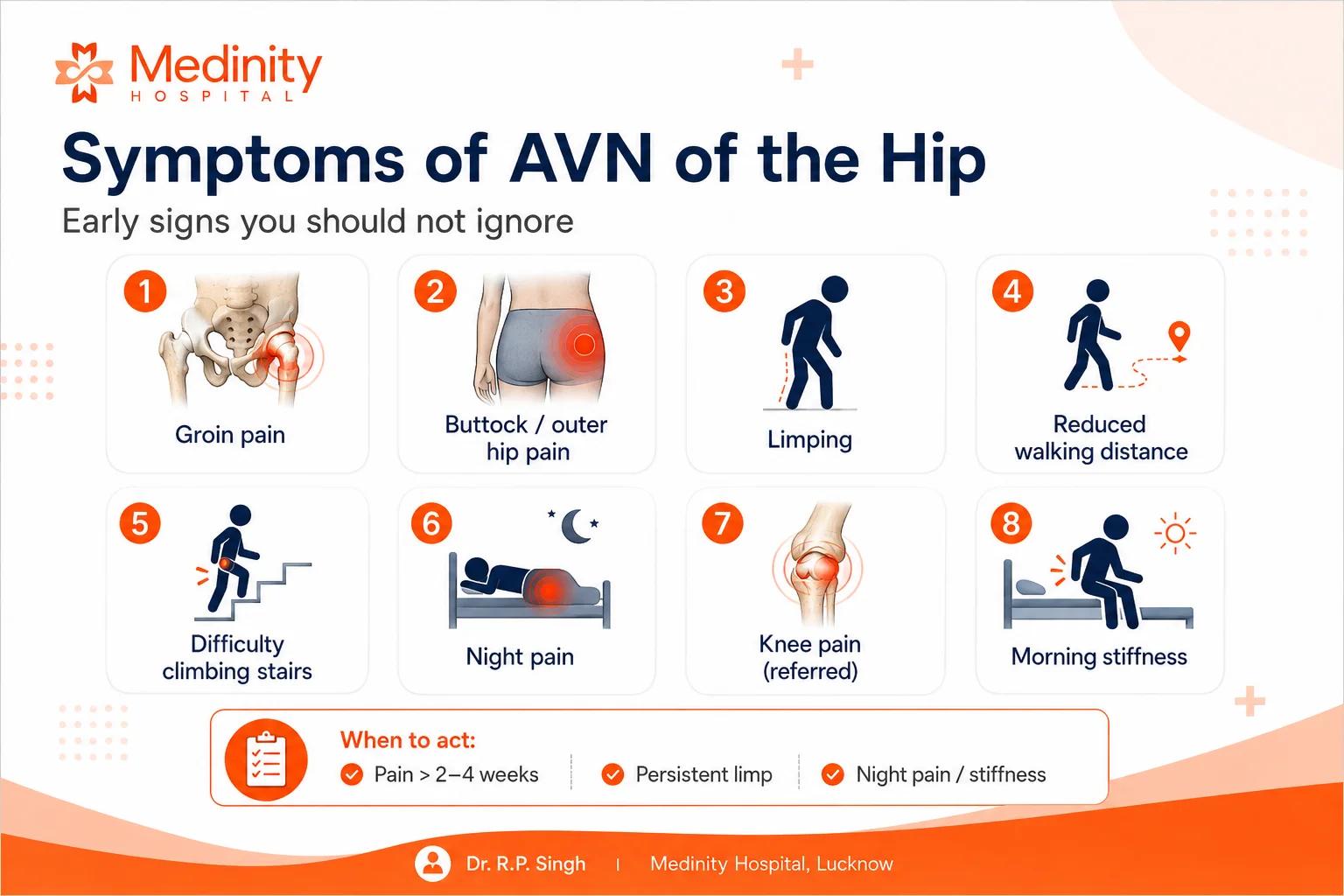
AVN symptoms are easy to miss in the early stages. Many patients dismissed by a general doctor in Lucknow later present to an AVN specialist at Medinity Hospital after 6 to 12 months of unexplained groin or hip pain. Knowing these signs can prevent that delay:
The referred knee pain trap
One of the most common delays in AVN diagnosis is patients with groin and knee pain who see a knee specialist first. The knee examination is normal, investigations show nothing, and months pass before anyone thinks to examine the hip. If you have unexplained knee pain in a patient aged 30 to 55 with no knee injury, always examine the hip. This is a standard check at Medinity Hospital's orthopaedic OPD in Gomti Nagar.
Consultation
Experiencing groin pain or unexplained hip stiffness in Lucknow?
CP-221, Hahnemann Medinity Hospital Road, Gomti Nagar, Lucknow 226010 · Walk-in OPD · 24/7 emergency
What causes AVN of the hip, and why is it common in younger patients in India?
AVN affects a much younger age group than arthritis. The reason is that its causes are not age-related. They are lifestyle and treatment-related.
In India, steroid-induced AVN accounts for a disproportionately high proportion of cases compared to Western populations (Agarwala et al., Indian Journal of Orthopaedics, 2019). Crucially, steroid-induced AVN commonly affects both hips simultaneously, even when only one is symptomatic. Dr. R.P. Singh, hip specialist in Lucknow, always images both hips in every AVN patient regardless of which side the patient presents with.
How is AVN of the hip diagnosed? X-ray versus MRI
Standard X-rays are unreliable in the early stages. A patient can have significant bone death and a completely normal X-ray. MRI is the investigation of choice.
MRI at Medinity Hospital's NABL-accredited diagnostics centre in Gomti Nagar, Lucknow can detect Stage 1 AVN with high sensitivity before any X-ray changes appear. This is the single most important early intervention available for AVN patients in Lucknow.
If you have hip pain plus a risk factor for AVN (steroid use, alcohol, trauma), request an MRI specifically. Do not accept a normal X-ray as a final answer. Dr. R.P. Singh at Medinity Hospital, Lucknow, regularly sees patients whose X-ray was reported as normal but whose MRI showed Stage 1 or 2 AVN with significant lesion size.
The 4 stages of AVN of the hip, and why early diagnosis changes everything
The Ficat and Arlet classification, first described in 1980 and still the most widely used staging system in international orthopaedics, divides AVN into four stages. Every treatment decision at Medinity Hospital begins with accurate staging.
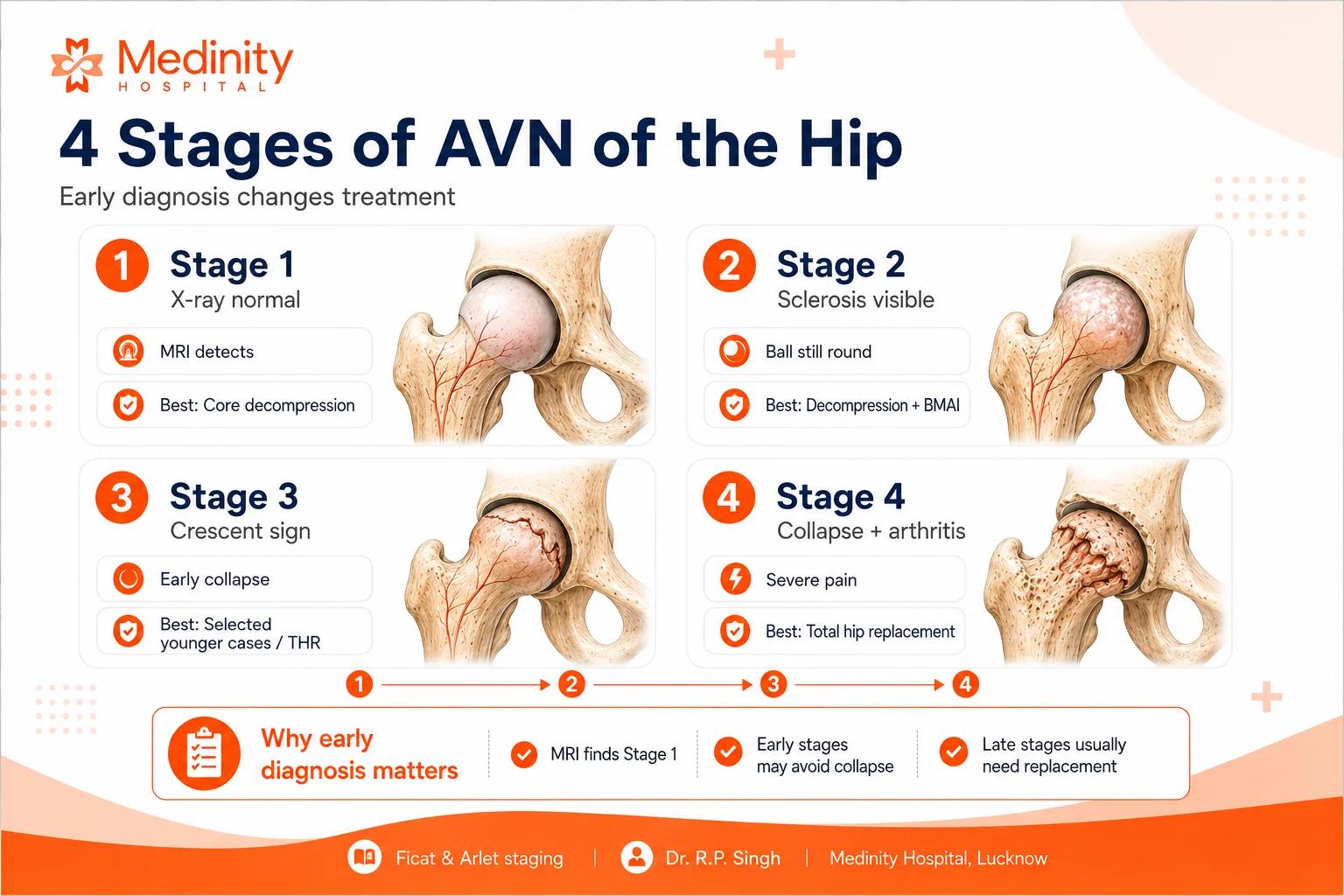
Stage 1: Early disease (no X-ray changes)
Stage 2: Sclerosis visible (ball still round)
Stage 3: Crescent sign (early collapse)
Stage 4: Collapse (secondary arthritis)
How quickly does AVN of the hip progress from one stage to the next?
The rate of progression varies by cause and lesion size, but the overriding message is consistent across the published literature: AVN progresses faster than most patients expect, and delay rarely serves the patient's interest.
No patient with a confirmed Stage 2 AVN lesion affecting more than 15% of the femoral head should wait more than 4 to 6 weeks before making a treatment decision. Every additional month without treatment is a month closer to a Stage 3 collapse that cannot be reversed without hip replacement.
Consultation
Diagnosed with Stage 1 or Stage 2 AVN? Book an assessment before the window closes.
CP-221, Hahnemann Medinity Hospital Road, Gomti Nagar, Lucknow 226010 · Walk-in OPD · 24/7 emergency
Can AVN of the hip be treated without surgery? Dr. R.P. Singh's honest answer
At Stage 1, a small proportion of patients with very small lesions improve with protected weight-bearing alone. For most, however, waiting risks rapid progression. Core decompression at Stage 1 is a minor procedure with an excellent risk-benefit ratio.
At Stage 2, conservative management alone is insufficient. Core decompression gives a 70 to 80% chance of halting progression (Hernigou et al. meta-analysis, Journal of Bone and Joint Surgery). At Stages 3 and 4, no conservative treatment can reverse a collapsed femoral head. Surgery is the only reliable option.
Core decompression vs hip replacement
The most common clinical question in AVN: can we save the hip or does it need to be replaced? Here is the side-by-side comparison:
For younger AVN patients who do need hip replacement, implant selection is critical. A 35-year-old AVN patient potentially has 45 to 50 years ahead. Dr. R.P. Singh uses ceramic-on-ceramic implants for AVN patients under 50 because of their 30 to 35 year lifespan (Cheung et al., 97.1% survival at 19 years). For more on hip replacement at Medinity Hospital, see our complete guide to hip replacement surgery in Lucknow.
Cost of AVN treatment in Lucknow
Here is a transparent cost framework for AVN treatment at Medinity Hospital and the general Lucknow market for 2025/2026:
Insurance coverage
Most cashless health insurance policies in India cover core decompression and hip replacement surgery for AVN as recognised surgical procedures. MRI coverage depends on your specific policy. Pre-authorisation is required before any planned surgery. Medinity Hospital works with major insurance providers. Call +91 94540 99331 to check whether your insurer is a network provider.
Medinity Hospital provides a written, itemised cost estimate before any surgical decision. To receive a cost framework for your specific stage and treatment option, call +91 94540 99331 or book a consultation with Dr. R.P. Singh in Gomti Nagar, Lucknow.
AVN treatment at Medinity Hospital: what to expect
Dr. R.P. Singh is a hip replacement surgeon in Lucknow with a specific focus on AVN of the hip. His practice draws patients from Indira Nagar, Aliganj, Jankipuram, Hazratganj, and Alambagh within Lucknow, as well as from Sitapur, Hardoi, Barabanki, Raebareli, Kanpur, and Unnao. Many come specifically because complex AVN cases require a surgeon with fellowship-level joint reconstruction training.
Your Care Pathway
- 1Consultation: Focused history covering steroid use, alcohol, trauma, and pain pattern. Clinical examination includes axis deviation test and sectoral sign, two specific AVN findings frequently missed in general practice.
- 2Imaging: Weight-bearing X-ray of both hips. MRI at Medinity's NABL-accredited diagnostics centre if AVN suspected. CT for surgical planning where needed.
- 3Staging: Ficat and Arlet Stage 1 to 4 assigned. MRI lesion size and location in the weight-bearing zone determines treatment pathway.
- 4Treatment: Stage 1 to 2 patients offered core decompression with BMAI where appropriate. Stage 3 to 4 assessed for joint replacement surgery in Lucknow. All options explained in plain language.
- 5Recovery: Physiotherapy from day 1. Follow-up at 6 weeks, 3 months, 6 months, and annually. MRI at 6 months post core decompression to confirm treatment response.
Why patients choose Medinity Hospital for AVN treatment
- ★Dr. R.P. Singh: MS Ortho (Gold Medalist), Fellowship Joint Replacement, USA and Germany
- ★Experience: 20+ years of orthopaedic practice, 2,000+ surgeries performed
- ★Advanced Testing: Axis deviation test and sectoral sign assessed at every AVN consultation
- ★Dual Imaging: Both hips always imaged, even when only one side is symptomatic
- ★Quality Standards: NABH-accredited hospital | NABL-accredited diagnostics
- ★Patient Satisfaction: 4.8 stars from 246+ verified Google reviews
- ★Regional Trust: Patients from Lucknow, Sitapur, Hardoi, Barabanki, Raebareli, Kanpur, Unnao and across UP
Help centre
Frequently asked questions about AVN of the hip in Lucknow
Candidacy, diagnosis, staging, and preservation options.
AVN of the hip is manageable and in early stages can be halted or reversed in terms of symptoms, but 'curable' depends on the stage. At Stage 1, core decompression combined with stopping the causative factor gives approximately 70 to 80% of patients a stable hip without further intervention. At Stage 2, core decompression with bone marrow aspirate injection stabilises 83% of lesions. At Stages 3 and 4, where collapse has occurred, the joint cannot be restored to normal, but total hip replacement reliably eliminates pain and restores function in over 90% of patients.
The first symptom of AVN is typically a deep ache or sharp pain in the groin or inner thigh. This is often intermittent at first and may be confused with a muscle strain or groin pull. In some patients, the first symptom is unexplained knee pain on the same side, caused by referred pain from the hip joint. Any persistent groin pain in a patient with a known risk factor for AVN (steroid use, alcohol, hip trauma) should be investigated with an MRI, even if a previous X-ray was normal.
Not in the early stages. Stage 1 AVN appears normal on X-ray. Stage 2 shows sclerosis (a dense white area) inside the femoral head. The crescent sign, a thin dark line under the cartilage surface, appears at Stage 3 and indicates a subchondral fracture has occurred. Stage 4 shows visible collapse, deformity, and joint space narrowing. MRI is the investigation of choice for detecting AVN at Stage 1 and 2, before X-ray changes appear. A normal X-ray in a patient with hip pain and AVN risk factors does not rule out early disease.
The best treatment for Stage 2 AVN of the hip, supported by current evidence, is core decompression combined with bone marrow aspirate injection (BMAI). A 2024 PMC study found that 83% of Stage 2 lesions remained stable at 12-month follow-up with this approach, significantly outperforming standard core decompression alone PMC, 2024. Stage 2 is the most important treatment window in AVN because the femoral head has not yet collapsed. After successful core decompression, MRI follow-up at 6 months is essential to confirm treatment response.
Core decompression is most successful at Stage 1 and early Stage 2, with published success rates of 70 to 80% in preventing progression to femoral head collapse Hernigou et al. meta-analysis, Journal of Bone and Joint Surgery. Success rates are lower for larger lesions affecting more than 30% of the femoral head and for patients who continue the causative factor (steroids or alcohol) after surgery. Core decompression is significantly less effective at Stage 3 and is not indicated at Stage 4. Patient selection is the most important determinant of outcome.
Without treatment, almost all patients with Stage 2 AVN and above will progress to femoral head collapse and secondary arthritis within 1 to 3 years. Steroid-induced and traumatic AVN progress fastest. Once the femoral head collapses (Stage 3 to 4), pain becomes constant and severe, walking distance reduces dramatically, and daily activities are significantly affected. At this point, only total hip replacement reliably restores function. The tragedy is that Stage 3 and 4 disease is largely preventable with early Stage 1 and 2 diagnosis and treatment.
Not necessarily. Patients at Stage 1 and 2 can often be treated with core decompression without hip replacement. Core decompression has a 70 to 80% success rate at preventing progression to collapse (Hernigou et al. meta-analysis). Only Stage 3 and 4 AVN, where the bone has already collapsed, reliably requires hip replacement. Book an MRI assessment with Dr. R.P. Singh at Medinity Hospital before making any decisions.
Short courses of 1 to 2 weeks are generally not associated with AVN. The risk is primarily with prolonged use at higher doses, such as prednisolone 30 mg or more per day for several weeks to months. If you have taken a prolonged steroid course and developed hip pain, request an MRI. A normal X-ray does not rule out early AVN.
Bilateral AVN is extremely common in steroid-induced and alcohol-related cases. Studies show 40 to 50% of patients with AVN in one hip have bilateral disease. Dr. R.P. Singh images both hips in every AVN patient at Medinity Hospital, even if only one side is symptomatic, to detect early-stage disease in the second hip while it is still treatable.
Small Stage 1 lesions have a 20 to 30% chance of spontaneous improvement with rest and cessation of the causative factor (AAOS guidelines). Larger lesions and most Stage 2 lesions will progress without intervention. Core decompression at Stage 1 is a minor procedure with a 70 to 80% success rate. The downside of waiting and progressing to Stage 3 is hip replacement. Most orthopaedic specialists recommend not waiting once a significant lesion is confirmed on MRI.
If the underlying causative factor continues (steroids or alcohol), AVN can affect the other hip or recur. Core decompression treats the existing lesion but cannot prevent new AVN if the cause continues. Stopping the causative factor is therefore as important as the procedure itself.
Low-impact walking on flat surfaces is encouraged as it maintains muscle strength. High-impact activities including running, jumping, and deep squats must be avoided as they accelerate femoral head collapse. In Stages 3 and 4, protected weight-bearing with crutches reduces pain until surgery. Your physiotherapist at Medinity Hospital will provide a programme appropriate for your stage.
Not at Stage 1. Some Stage 1 patients have no pain at all and their AVN is found incidentally on MRI. Mild intermittent groin pain may be the only symptom at Stage 1 and 2. Pain becomes more constant and severe at Stage 3 and 4, and night pain develops. The absence of significant pain at early stages is a major reason patients delay assessment until the disease has progressed to a less treatable stage.
AVN of the hip is treated by an orthopaedic surgeon specialising in joint preservation and joint replacement. Dr. R.P. Singh at Medinity Hospital, Gomti Nagar, Lucknow, is an MS Ortho Gold Medalist with fellowship training from the USA and Germany. He is a hip specialist in Lucknow who assesses both hips at every AVN consultation, uses the Ficat and Arlet staging system, and offers the full spectrum from core decompression to ceramic-on-ceramic hip replacement. Call +91 94540 99331 to book a consultation.
Dr. R.P. Singh Explains AVN Stages & Treatment Options
In this medical video guide, Dr. R.P. Singh highlights how Avascular Necrosis (AVN) progresses and why early detection is critical for joint-preserving options.

About the author
Dr. R.P. Singh
MS Ortho (Gold Medalist) · Fellowship Joint Reconstruction (USA, Germany) · Senior Orthopaedic Surgeon
- 20+ years experience
- 2,000+ surgeries
- Partial & total knee replacement
Dr. R.P. Singh leads orthopaedics at Medinity Hospital, Gomti Nagar. He specialises in both joint preservation and replacement, bringing international, evidence-based surgical standards to Lucknow.
View full profile & credentialsConsultation
Book a consultation at Medinity Hospital, Lucknow
The most important step in AVN is finding out your stage before it is too late for joint-preserving treatment. Dr. R.P. Singh, Senior Orthopaedic Surgeon and hip specialist in Lucknow, will review your MRI, assess both hips, stage your disease accurately, and give you a clear recommendation in plain language. No pressure to commit to surgery at the first consultation.
- NABH-accredited hospital with a 4.8-star rating from 246+ verified patients
- Walk-in OPD available. Emergency orthopaedic care 24 hours a day, 7 days a week
CP-221, Hahnemann Medinity Hospital Road, Gomti Nagar, Lucknow 226010 · Walk-in OPD · 24/7 emergency
This article is based on clinical experience, peer-reviewed orthopaedic literature, and current international treatment guidelines. Medical information is accurate to the date of review. Readers should consult an orthopaedic specialist for individual medical advice.