Quick answers
What is kinematic knee replacement?
Kinematic alignment is a surgical technique that positions the knee implant to match the patient's own pre-arthritic anatomy, not a standardised axis. The result is a knee that moves the way YOUR knee naturally moved before arthritis. Approximately 95% of patients benefit from this personalised approach.
Is kinematic knee replacement better than traditional?
For appropriate patients, yes. A 2026 systematic review (Cureus) showed Oxford Knee Score improved by +6.2 and WOMAC by -9.8 compared to mechanical alignment. Best results are seen in patients with mild-to-moderate varus (bow-legged) deformity. Not every patient is an ideal candidate.
What is recovery time after kinematic knee replacement?
Most patients walk the day after surgery. Daily activities resume by 6 to 8 weeks. Full recovery and natural-feel adaptation takes 6 to 12 months. This timeline is similar to standard knee replacement - the difference is in the quality of movement and natural feel, not the recovery speed.
What is the success rate of kinematic knee replacement?
Comparable to standard knee replacement at mid-term follow-up (0 to 2% revision rate). Patient satisfaction is higher with kinematic alignment, particularly on measures of natural feel (Forgotten Joint Score). Long-term 10+ year data is still accumulating.
How much does kinematic knee replacement cost in Lucknow?
Cost at Medinity Hospital, Lucknow, depends on the implant system and technology used. [FILL IN ₹ RANGE WITH DR. R.P. SINGH'S INPUT]. Most major insurance policies cover knee replacement surgery. Call +91 94540 99331 for a written cost estimate.
Which implant is best for kinematic knee replacement?
The Medacta GMK SpheriKA is the world's first and only implant specifically designed for kinematic alignment, with a trochlear groove engineered for patient-specific patellar tracking. Other standard implants (Zimmer Persona, DePuy Attune, Smith+Nephew Journey II) are also used with KA technique. Dr. R.P. Singh will confirm the implant used at Medinity Hospital at your consultation.
After knee replacement surgery, most patients want the same thing: a knee that does not feel like a foreign object. For decades, traditional knee replacement delivered excellent pain relief - but some patients felt their new joint moved differently from their natural knee.
Kinematic alignment is a surgical approach designed to address this. Rather than positioning every implant along a standard axis, kinematic alignment restores the patient's own pre-arthritic knee geometry. In appropriately selected patients, this produces a knee that moves more naturally, requires fewer soft-tissue releases during surgery, and scores higher on measures that capture the natural feel of the joint.
Dr. R.P. Singh, Senior Orthopaedic Surgeon at Medinity Hospital, Gomti Nagar, Lucknow, incorporates contemporary knee replacement techniques into every patient assessment. Patients from Lucknow, Sitapur, Hardoi, Barabanki, Raebareli, Kanpur, Faizabad, Sultanpur, Ayodhya, Bahraich, Gonda, Lakhimpur, and Shahjahanpur who are considering knee replacement should understand this option before their consultation.
What is kinematic alignment in knee replacement?
For over 30 years, the dominant approach to knee replacement has been mechanical alignment. The concept: position the implant so a perfectly straight line can be drawn from the hip through the knee to the ankle. Every patient receives the same alignment regardless of how their knee functioned before arthritis.
This works well and has an excellent long-term track record. But it has one significant limitation: only approximately 5% of people have a natural knee anatomy that exactly matches the neutral mechanical axis. For the other 95%, mechanical alignment changes the knee's natural geometry.
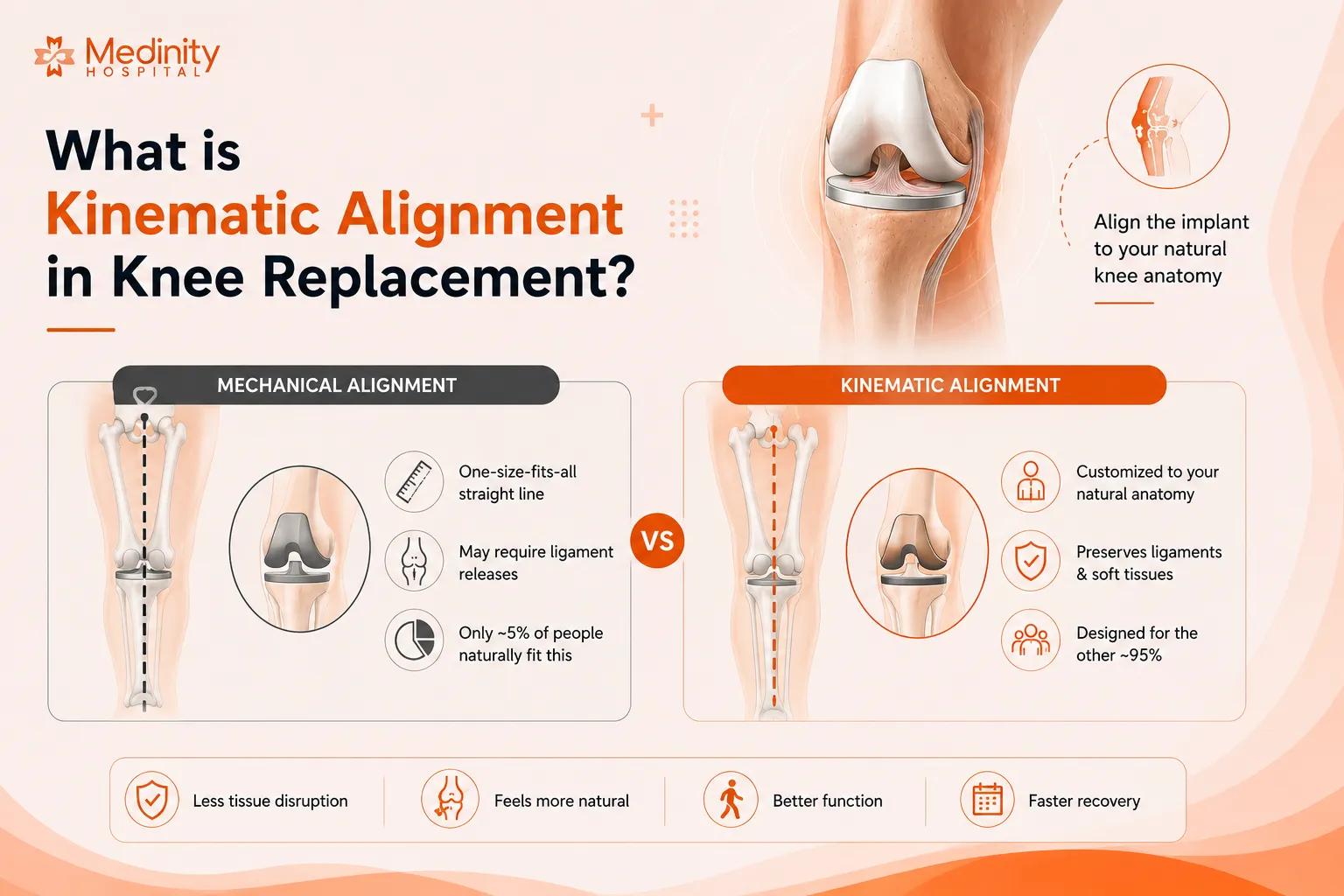
Kinematic alignment takes a different philosophy. Before surgery, the surgeon studies the patient's own knee anatomy: the natural angle of the joint line, the rotation of the femur and tibia, and how the knee moved before arthritis developed. The implant is then positioned to reproduce that individual anatomy.
In the kinematic approach, ligaments and soft tissues are left in their natural state of tension because the implant is placed where the knee naturally sits. Traditional alignment sometimes requires releasing ligaments to achieve straight-line balance. Kinematic alignment typically requires fewer or no such releases - meaning less disruption to the structures that stabilise the joint.
"The most common question I am asked at Medinity Hospital by patients from Lucknow and across eastern UP is: 'Will my knee ever feel like my own?' With mechanical alignment, the honest answer is sometimes no - particularly for patients with a naturally bow-legged alignment whose leg is straightened significantly during surgery. With kinematic alignment, we aim to restore what they had. [REPLACE WITH DR. R.P. SINGH'S ACTUAL WORDS ABOUT HIS EXPERIENCE WITH THIS QUESTION AT MEDINITY]"
Kinematic alignment versus traditional mechanical alignment: a direct comparison
For information on standard total knee replacement, see our complete guide: total knee replacement in Lucknow.
Kinematic alignment versus robotic knee replacement: what is the difference?
This is one of the most common points of confusion for patients researching modern knee replacement options. Kinematic alignment and robotic surgery are two different things that are often, but not always, used together.
The best outcome comes from combining the right philosophy with the right execution: kinematic alignment planned correctly and executed with high precision, whether by navigation, robotic assistance, or an experienced surgeon using specialised instruments.
Kinematic total knee replacement versus partial knee replacement: how to decide
Both kinematic alignment total knee replacement and partial knee replacement aim to preserve more of the patient's natural anatomy compared to traditional total knee replacement. But they address different situations:
See our complete guide to partial knee replacement in Lucknow to understand whether partial replacement might be an option for your case.
"One of the most common clinical mistakes I see is patients being told they need a total knee replacement when their arthritis is actually confined to one compartment and their ACL is intact. A proper assessment matters enormously. Similarly, patients with multi-compartment arthritis who come expecting a partial replacement sometimes need a total knee - and kinematic alignment in that total knee gives them the best chance of a result that feels similar to the partial they were hoping for. [REPLACE WITH DR. R.P. SINGH'S ACTUAL WORDS]"
Why does a kinematically aligned knee feel more natural? The clinical explanation
The question Dr. R.P. Singh hears most often at his Medinity Hospital clinic from knee replacement candidates in Lucknow, and from patients travelling from Ayodhya, Faizabad, Sultanpur, and Bahraich, is: will my knee ever feel normal again?
When a knee replacement matches the patient's own geometry, the ligaments remain in their natural tension. The knee flexes and rotates along the same axis it always has. The body does not have to re-learn a different movement pattern.
+6.2
Oxford Knee Score improvement (KA vs mechanical, Cureus 2026)
-9.8
WOMAC improvement (lower = less pain/stiffness, Cureus 2026)
Higher FJS
Kinematic patients forget their artificial joint more often
Researchers measure natural feel using the Forgotten Joint Score (FJS): how often do patients notice their artificial knee during daily activities? High FJS means the patient rarely thinks about the knee. A 2025 systematic review (14 studies) found kinematic alignment improved FJS particularly in varus patients. PMC 2025, PMC12590092.
"In my experience at Medinity Hospital, patients who had a naturally bow-legged knee before arthritis often adapt extremely well to kinematic alignment. We restore their native anatomy instead of forcing every knee into one standard straight-leg alignment. The brain and nervous system adapt faster to a geometry that matches what the body already knows. [REPLACE WITH DR. R.P. SINGH'S ACTUAL WORDS]"
Who is an ideal candidate for kinematic knee replacement at Medinity Hospital?
For patients exploring alternatives, see non-surgical knee pain treatment in Lucknow and partial knee replacement in Lucknow.
What does the published evidence show about kinematic knee replacement?
"The evidence has now matured to the point where I am confident in recommending kinematic alignment to the right patient. What I tell patients at Medinity Hospital is this: the long-term survival data is still coming in, but the mid-term patient-reported outcomes are consistently better with kinematic alignment for patients with varus anatomy. The knee feels more like theirs. That matters enormously to a patient who will live with this joint for 20 years. [REPLACE WITH DR. R.P. SINGH'S ACTUAL WORDS]"
How is kinematic knee replacement planned and performed?
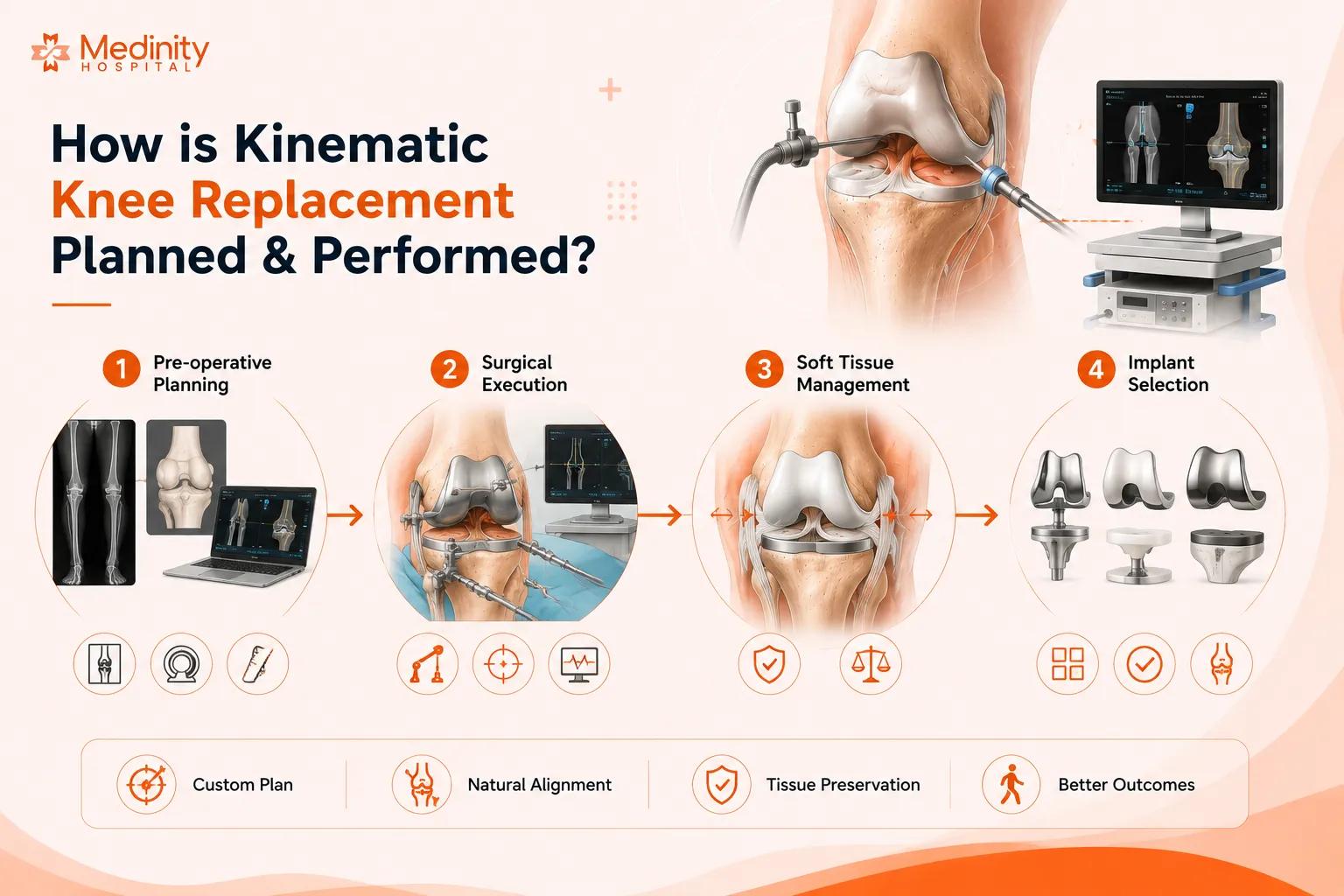
In general kinematic alignment practice, the pre-operative and intraoperative process works as follows:
- Pre-operative planning: The surgeon analyses the patient's knee anatomy using weight-bearing X-rays and, in many centres, CT or MRI imaging. Measurements are taken of the natural joint line angle, femoral rotation, and tibial slope.
- Surgical execution: During surgery, bone cuts are made at angles specific to that patient's anatomy rather than standardised angles. Navigation or robotic systems can assist with precision.
- Soft tissue management: Because the implant is positioned in the knee's natural plane, the ligaments typically balance without requiring releases.
- Implant selection: Kinematic alignment can be performed with most standard implant systems. Some designs are specifically engineered to accommodate kinematic alignment.
Recovery after kinematic knee replacement: what to expect week by week
Recovery after kinematic alignment broadly follows the same timeline as standard total knee replacement. The natural-feel advantage becomes more noticeable during months 3 to 6 as the brain and nervous system adapt to the restored knee geometry.
Day 1 to 3
Most patients stand and take first steps with support within 24 hours. Swelling peaks at days 3 to 5. Ice 15 to 20 minutes every 2 to 3 hours. Leg elevated above heart level. Ankle pumps begin immediately. [CONFIRM MEDINITY DAY 1 PROTOCOL]
Week 1 to 2
Physiotherapy begins at Medinity Hospital. Target 90 degrees of knee flexion by end of week 2. Quad sets, straight leg raises, heel slides. Swelling reducing. [CONFIRM MEDINITY FLEXION TARGET]
Week 3 to 6
Walking without aid in most patients. Driving: typically week 4 to 6 for right knee. Stairs manageable by week 3. Physiotherapy continues with progressive strengthening.
Month 2 to 3
Most daily activities resumed. Swimming cleared at 6 to 8 weeks once wounds healed. The kinematic advantage begins: movement feels more intuitive as the brain adapts to the restored joint geometry.
Month 6 to 12
Full adaptation. Patients with KA often report more natural gait and increased movement confidence. The Forgotten Joint Score outcome is most strongly observed - the knee becomes less of a conscious presence.
"The patients who surprise me most in the months after kinematic replacement are those from cities further from Lucknow - from Gonda, Lakhimpur, and Shahjahanpur - who come for their 3-month follow-up having returned to full farm work or household activity much more comfortably than they expected. The common feedback is: it moves more like mine used to. That is the best outcome measurement there is. [REPLACE WITH DR. R.P. SINGH'S ACTUAL WORDS]"
Does Dr. R.P. Singh perform kinematic knee replacement at Medinity Hospital, Lucknow?
At Medinity Hospital, Gomti Nagar, Lucknow, Dr. R.P. Singh performs [kinematic / navigation-assisted kinematic / modified kinematic] total knee replacement for appropriate patients. Using [CT planning / navigation system / robotic / manual instruments with specialised cutting blocks], the pre-arthritic knee axis is reproduced for each patient. The implant system used is [NAME]. Patients who want to know whether kinematic alignment is an option for their specific case are assessed using [imaging protocol] at the pre-operative consultation.
Why patients from across Lucknow and UP choose Medinity Hospital for knee replacement
- ★Dr. R.P. Singh: MS Ortho (Gold Medalist), Fellowship Joint Reconstruction, USA and Germany
- ★20+ years of orthopaedic practice, 2,000+ orthopaedic surgeries performed
- ★Contemporary alignment techniques discussed at every knee replacement consultation at Medinity Hospital
- ★NABH-accredited hospital | NABL-accredited diagnostics - pre-operative imaging on campus in Gomti Nagar
- ★Integrated physiotherapy department - rehabilitation from day 1 after surgery
- ★4.8-star rating from 246+ verified Google reviews
- ★Patients served from Lucknow, Sitapur, Hardoi, Barabanki, Raebareli, Kanpur, Faizabad, Sultanpur, Ayodhya, Bahraich, Gonda, Lakhimpur, Shahjahanpur and across Uttar Pradesh
Consultation
Find out if kinematic knee replacement is right for you - Medinity Hospital, Lucknow.
If you are considering knee replacement and want a knee that moves as naturally as possible, kinematic alignment may give you that outcome. Dr. R.P. Singh at Medinity Hospital, Gomti Nagar, Lucknow, will assess your anatomy, explain which approach best suits your specific knee, and give you an honest recommendation.
- Emergency orthopaedic care 24/7
- Consultations 6 days a week
- Walk-in OPD available
CP-221, Hahnemann Medinity Hospital Road, Gomti Nagar, Lucknow 226010 · Walk-in OPD · 24/7 emergency
Help centre
Frequently asked questions
Understanding kinematic alignment, candidacy, recovery and more.
Yes. Bilateral simultaneous kinematic total knee replacement is possible in carefully selected patients where both knees need replacement, general health is good, and BMI is manageable. Both implants are positioned to match each knee's individual pre-arthritic anatomy, not to each other. Dr. R.P. Singh assesses each knee independently at Medinity Hospital. If one knee is clearly less severe, a staged approach (one at a time) is generally recommended to allow full recovery between procedures.
Obesity increases surgical complexity, anaesthetic risk, and implant loading. A BMI above 40 is a relative contraindication for any elective knee replacement, including kinematic alignment. Patients with BMI between 35 and 40 can often proceed with appropriate pre-operative medical optimisation. For patients with very high BMI, Dr. R.P. Singh at Medinity Hospital will discuss the realistic risk-benefit balance and may recommend weight loss before surgery as a first step. Weight loss of even 5 to 10 kg meaningfully reduces surgical risk and improves outcome.
Yes, in two important ways. First, uncontrolled diabetes (HbA1c above 8) doubles infection risk after any joint replacement surgery. Surgery at Medinity Hospital is not scheduled until blood glucose is adequately controlled. Second, neuropathy (nerve damage from long-term diabetes) can slow the proprioceptive adaptation that makes kinematic alignment feel natural. Patients with well-controlled diabetes undergoing kinematic replacement at Medinity Hospital typically achieve equivalent outcomes to non-diabetic patients when blood sugar management is optimised before and after surgery.
Yes. Kinematic alignment can be performed with either cemented or cementless implant fixation. Cementless implants rely on bone growing into a porous surface over 6 to 12 weeks, making them particularly suited to younger, more active patients with good bone quality. Cemented fixation remains the gold standard for most patients, with the longest survivorship data. The choice between cemented and cementless depends on patient age, bone quality, and activity level. Dr. R.P. Singh will discuss which fixation type is appropriate for your specific anatomy at Medinity Hospital.
Kneeling is possible for many patients after full recovery, typically at 6 to 12 months, but it can be uncomfortable even with a well-functioning knee replacement. The discomfort is usually from skin sensation over the front of the knee near the portal sites, not from the implant itself. Kinematic alignment may make kneeling slightly more comfortable than traditional alignment because the joint is in a more natural position. Using a soft pad under the knee helps most patients. Always check with Dr. R.P. Singh before resuming kneeling activities.
Light squatting for activities of daily living (picking something up from the floor, getting up from a low chair) is usually possible by 3 to 6 months after recovery. Deep squats (below 90 degrees) are generally not recommended as they place high stress on the implant and increase wear rate over time. Kinematic alignment, by reproducing the natural knee geometry, typically allows better flexion than traditional alignment. However, very deep squatting and Indian-style sitting should be assessed individually with Dr. R.P. Singh.
Most patients can travel short distances by car from 2 to 3 weeks. Air travel of more than 2 to 3 hours carries a higher risk of deep vein thrombosis (blood clots) in the first 6 weeks after any major joint surgery. For longer flights, wait until 6 to 8 weeks post-surgery, wear compression stockings, walk the aisle every 30 to 45 minutes, and stay well hydrated. Before planning international travel, discuss with Dr. R.P. Singh at Medinity Hospital and arrange continuation of blood-thinning medication if appropriate.
Yes, without exception. Physiotherapy is not an optional extra - it is the mechanism by which the kinematic alignment benefit is realised. The surgery restores the correct joint geometry. Physiotherapy trains the muscles and nervous system to use that geometry correctly. Patients who skip or inadequately complete physiotherapy achieve substantially worse outcomes regardless of surgical technique. At Medinity Hospital, Gomti Nagar, Lucknow, the physiotherapy department is integrated on the same campus, making it straightforward to begin rehabilitation from day 1 after surgery.
Kinematic alignment is a surgical technique that positions the knee implant to match the patient's own pre-arthritic knee anatomy, rather than a standardised mechanical axis. The goal is a knee that moves the way the patient's knee naturally moved before arthritis developed. It is sometimes called 'patient-specific alignment.' Only approximately 5% of people have a natural knee anatomy exactly matching the mechanical alignment neutral axis - kinematic alignment is designed for the other 95%.
For appropriate patients - particularly those with mild to moderate varus (bow-legged) deformity - kinematic alignment shows improved patient-reported outcomes including Oxford Knee Score (+6.2 points) and WOMAC (-9.8 points) at mid-term follow-up. It is not universally superior. Candidacy depends on anatomy, deformity severity, and clinical assessment. Dr. R.P. Singh at Medinity Hospital, Gomti Nagar, Lucknow, assesses each patient individually.
Yes, consistently in the published evidence. Kinematic alignment achieves higher Forgotten Joint Score results - patients are less aware of their artificial joint during daily activities. The 'natural feel' typically becomes more noticeable during months 3 to 6 as the brain adapts to the restored joint geometry. Patients with naturally bow-legged anatomy before arthritis most consistently report this benefit.
Ideal candidates include: patients with mild to moderate varus (bow-leg) deformity, preserved bone stock, active patients wanting to return to normal activities, and patients asking specifically for a 'natural-feeling' knee. Patients with severe deformity, revision surgery, or previous ligament reconstruction may be better suited to traditional mechanical alignment. A consultation with Dr. R.P. Singh determines suitability.
No. Kinematic alignment is a philosophy about WHERE to position the implant. Robotic surgery is a technology about HOW to execute that positioning. Robotic surgery can be used to perform kinematic alignment with higher precision, but kinematic alignment can also be performed using navigation or manual techniques. Similarly, robotic surgery can perform traditional mechanical alignment. They are complementary but separate concepts.
Broadly similar to standard total knee replacement: walking within 24 hours of surgery, daily activities by 6 to 8 weeks, full recovery and natural-feel adaptation over 6 to 12 months. The kinematic advantage becomes more apparent during months 3 to 6. Dr. R.P. Singh and the Medinity physiotherapy team provide a specific recovery programme for each patient.
Most patients manage stairs with a handrail by week 3. The technique: good leg up first, operated leg down first. By week 6, most manage stairs without assistance. Because kinematic alignment preserves the natural joint geometry, many patients find stair use feels more intuitive than what some describe after traditional replacement. Your physiotherapist at Medinity Hospital will guide stair progression.
Swimming is an excellent low-impact exercise and is generally cleared at 6 to 8 weeks once surgical wounds are fully healed. Buoyancy reduces joint load while allowing gentle range-of-motion movement. This is particularly beneficial during the kinematic adaptation phase when range of motion is being re-established. Dr. R.P. Singh will confirm swimming clearance at the follow-up appointment.
Cost depends on the implant system used, technology incorporated into the procedure, and the patient's specific needs. See our total knee replacement cost guide for a general framework. For a specific cost estimate, call Medinity Hospital on +91 94540 99331. [FILL IN SPECIFIC ₹ RANGE WITH DR. R.P. SINGH'S INPUT]
[FILL IN WITH DR. R.P. SINGH'S ACTUAL CONFIRMED ANSWER - most important FAQ on the page for conversion. Include: yes/no, technology used, implant name, what patients need to bring to the consultation to assess candidacy.]
Kinematic alignment refers to the alignment philosophy - restoring the patient's native geometry. Personalised knee replacement typically uses CT-scan-based 3D planning and patient-specific instrumentation (PSI) to execute that plan with maximum precision. The two concepts are often combined. See our guide on personalised knee replacement in Lucknow for more detail.
For earlier-stage arthritis, see our complete guide on non-surgical knee pain treatment in Lucknow. When arthritis reaches bone-on-bone stage with severe functional limitation and conservative treatment has failed, total or partial knee replacement becomes the most reliable long-term solution for most patients.

About the author
Dr. R.P. Singh
MS Ortho (Gold Medalist) · Fellowship Joint Reconstruction (USA, Germany) · Senior Orthopaedic Surgeon
- 20+ years experience
- 2,000+ surgeries
- Knee replacement expert
Dr. R.P. Singh is Senior Orthopaedic Surgeon at Medinity Hospital, Gomti Nagar, Lucknow. MS Orthopaedics with Gold Medal. Fellowship in joint reconstruction and sports injury, USA and Germany. 20+ years clinical experience. 2,000+ orthopaedic surgeries. Specialises in knee replacement surgery (total, partial, and kinematic alignment), hip replacement, arthroscopic surgery, and sports injury management.
View full profile & credentialsMedical disclaimer: This article is for educational purposes and does not replace professional medical consultation. Kinematic knee replacement must be assessed by a qualified orthopaedic surgeon before any surgical decision is made.