Quick answer: what happens when a shoulder dislocates and does it need surgery?
A shoulder dislocation occurs when the ball of the upper arm bone (humeral head) is forced out of the shoulder socket (glenoid). Approximately 95% of all shoulder dislocations are anterior, meaning the ball slips forward out of the socket. The shoulder must be relocated (reduced) by a doctor under muscle relaxation or anaesthesia, never by the patient themselves or an untrained person. After a first-time dislocation, young athletes under 20 have a recurrence rate exceeding 80% without surgery. Bankart surgery (arthroscopic repair of the torn labrum) is recommended for athletes with recurrent dislocation or following a first dislocation in high-risk young patients. Published data shows 84% return to sport after Bankart repair and only 12% recurrence rate when combined with remplissage at 6-year follow-up.
The shoulder is the most commonly dislocated major joint in the human body. For athletes in Lucknow, whether you play cricket, kabaddi, wrestling, or football, a shoulder dislocation is one of the most recognisable sports injuries. You feel it immediately: a pop, a sudden loss of shoulder shape, and pain that makes moving the arm impossible.
Dr. R.P. Singh, Senior Orthopaedic Surgeon at Medinity Hospital, Gomti Nagar, Lucknow, treats shoulder dislocations in athletes across all ages. The most important message he gives patients: a shoulder dislocation is not a minor injury. What you do in the first 30 minutes, and whether you treat the underlying instability afterward, determines whether you will dislocate it again.
What happens when a shoulder dislocates, and why the first 30 minutes matter
Your shoulder joint is designed for maximum mobility. The ball (humeral head) sits in a shallow socket (glenoid), held in place by the labrum (a ring of cartilage that deepens the socket), the joint capsule, and the surrounding muscles. This design gives you the widest range of motion of any joint in the body, but it also makes the shoulder the most unstable major joint.
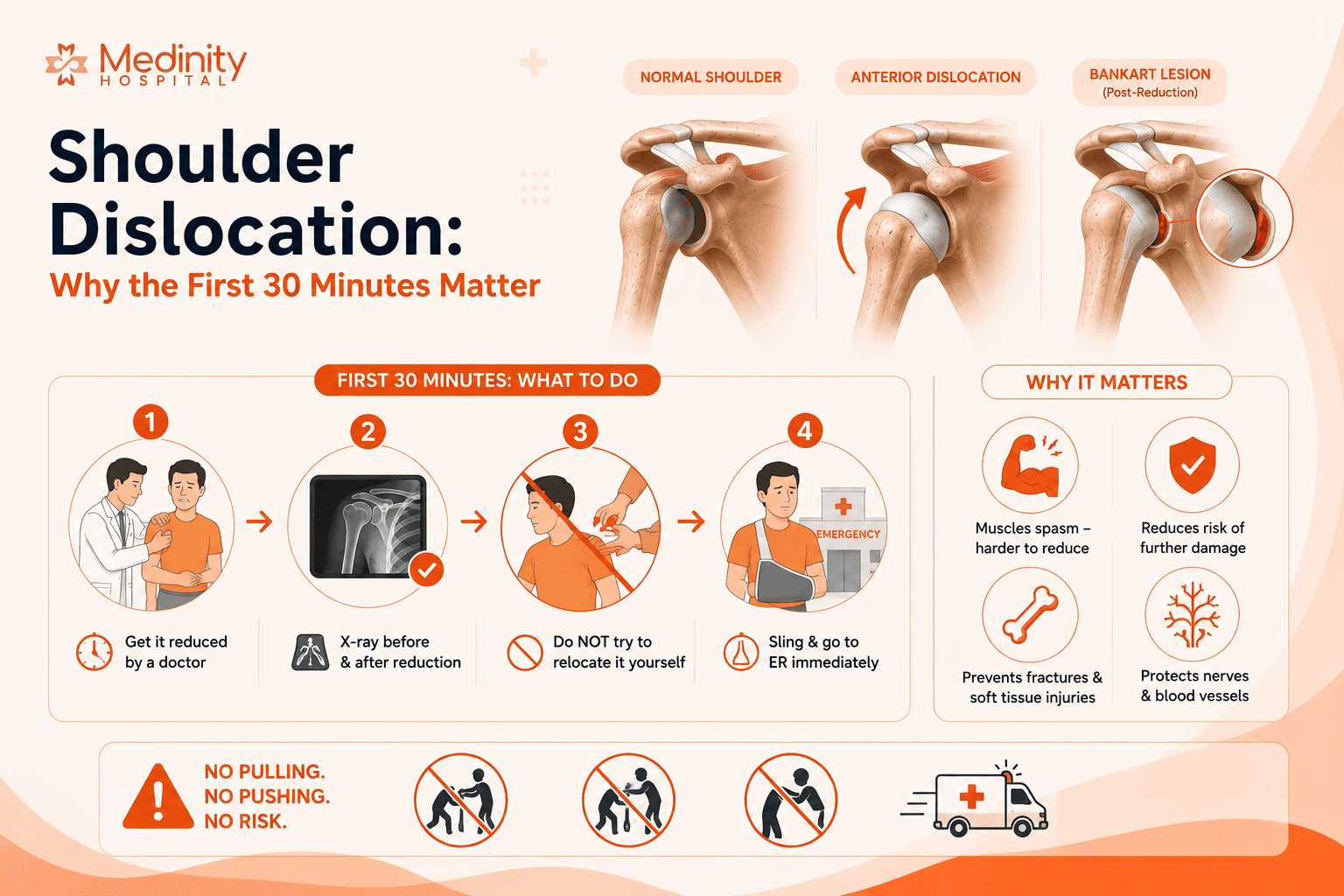
When the shoulder dislocates, the ball is forced out of the socket. This almost always tears the labrum, creating what is called a Bankart lesion. In severe cases, a dent is made in the back of the ball (Hill-Sachs lesion) from the ball striking the edge of the socket as it pops out. These structural injuries are what cause the shoulder to keep dislocating.
- ✗ Never try to 'pop it back in' yourself or allow anyone without orthopaedic training to attempt reduction
- ✗ Never apply heat to a dislocated shoulder — it increases swelling and makes reduction harder
- ✗ Never ignore a dislocated shoulder and wait to see if it improves — it will not
- ✗ Never resume playing sport with the shoulder still dislocated — this risks severe neurovascular damage
Shoulder dislocated playing sport in Lucknow? Call us or go to Medinity Hospital emergency immediately.
Consult Dr. R.P. Singh at Medinity Hospital, Gomti Nagar, Lucknow.
Call: +91 94540 99331
Symptoms of shoulder dislocation
A dislocated shoulder is usually obvious, but knowing exactly what to look for helps you act quickly and confidently. Common signs include:
- Sudden, severe pain in the shoulder at the moment of injury
- Visible deformity — the shoulder loses its normal rounded contour and looks ‘squared-off’ or out of place
- Inability to move the arm, or the patient actively resisting any attempt to move it
- Swelling and bruising around the joint
- Numbness, tingling, or weakness in the arm or hand, which can indicate nerve involvement
- A distinct sensation, and sometimes an audible pop, of the shoulder ‘popping out’ of its socket
- Muscle spasm around the shoulder that makes the arm feel locked in one position
If you notice any of these signs after a fall, tackle, dive, or collision, treat it as a medical emergency. The section below covers exactly what to do, and what never to do, in the first 30 minutes.
First aid for shoulder dislocation: what to do and what absolutely not to do
Most shoulder dislocations in Lucknow happen on cricket grounds, kabaddi courts, gyms, and road accidents. Here is the correct first aid protocol that every coach, team manager, and family member of an athlete should know:
Remove the player from the game. Do not allow them to continue playing. Do not try to 'shake it off'.
Support the arm in the position the patient is holding it, which is usually slightly away from the body with the forearm across the chest. Do not try to change this position.
A team shirt, scarf, or triangular bandage can be used to support the arm against the body. The sling should take the weight of the arm and keep it from moving.
Apply an ice pack wrapped in a cloth to the front of the shoulder for 15 to 20 minutes. Never apply ice directly to skin.
Call +91 94540 99331 or go directly to Medinity Hospital, Gomti Nagar, Lucknow. Emergency orthopaedic care is available 24/7.
If available and not contraindicated, an oral painkiller such as paracetamol or ibuprofen can be taken for the journey to hospital.
Anterior versus posterior shoulder dislocation: which is more common in cricketers?
The shoulder can dislocate in different directions. The direction determines the symptoms, the reduction technique, and the surgical approach if needed.
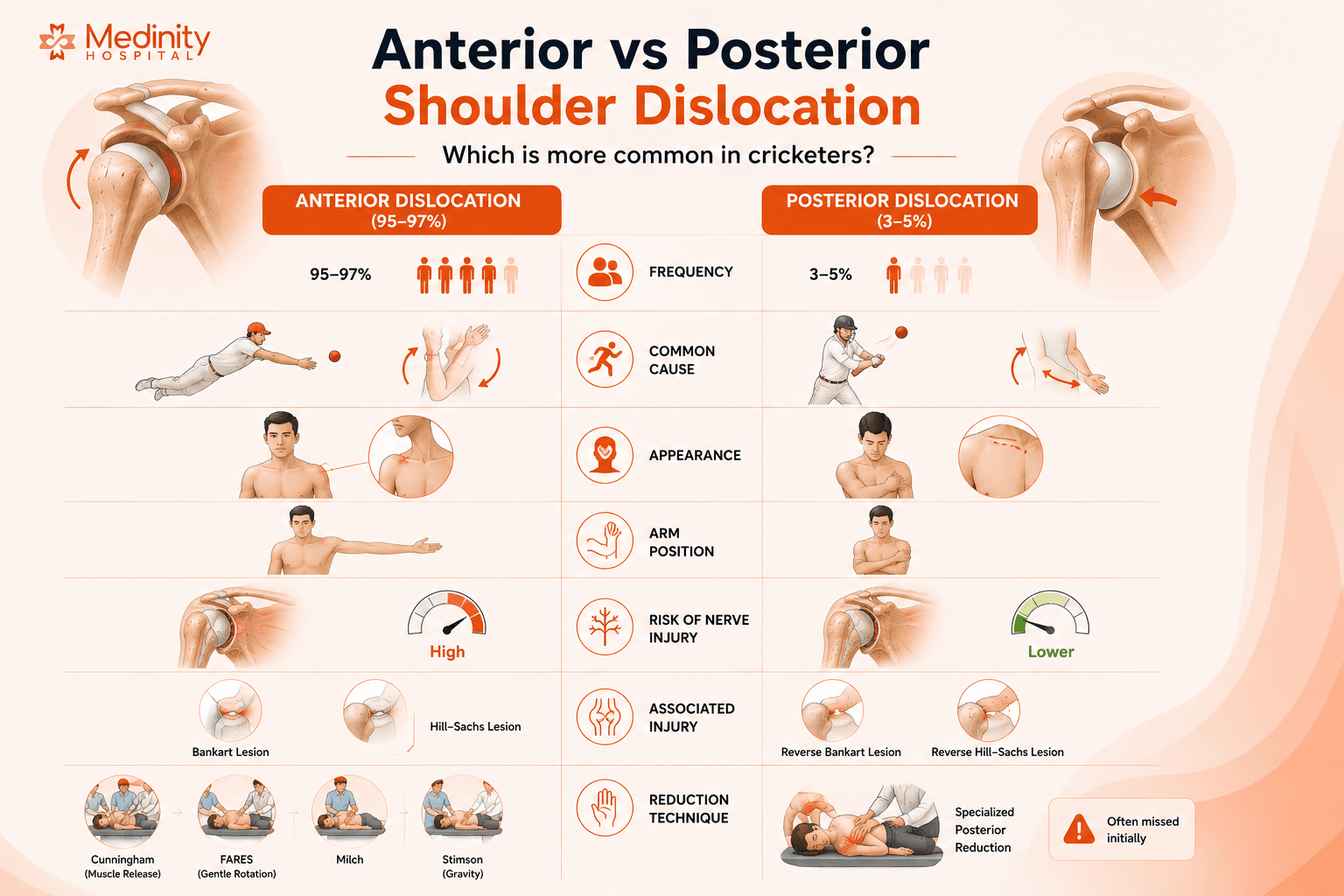
Posterior shoulder dislocation is frequently missed on initial assessment because the deformity is less obvious than anterior dislocation and the X-ray can appear almost normal unless specific views are taken. If a patient has severe shoulder pain after a road accident, fall, electric shock, or seizure and cannot externally rotate the arm, a posterior dislocation must be specifically excluded before the shoulder is cleared as 'normal'. At Medinity Hospital, axillary and scapular Y-view X-rays are taken whenever a posterior dislocation is suspected.
How shoulder dislocation is diagnosed
Getting the diagnosis right the first time, including catching injuries that are easy to miss, shapes the entire treatment plan. At Medinity Hospital, assessment of a suspected shoulder dislocation includes:
- Physical examination: checking shoulder shape, range of motion, and pulses and sensation in the hand to rule out nerve or blood vessel involvement
- X-ray, before and after reduction: confirms the direction of dislocation, rules out an associated fracture, and confirms the ball is correctly repositioned
- MRI: assesses soft-tissue injury, including the Bankart lesion, Hill-Sachs lesion, labrum, and rotator cuff, and guides the decision between surgery and physiotherapy. (Learn more about shoulder MRI scan Lucknow)
- CT scan: used when significant glenoid bone loss is suspected, to measure exactly how much bone has eroded and whether Latarjet surgery is preferred over Bankart repair
- Neurovascular assessment: specifically checks the axillary nerve and the blood supply to the arm, since these can be affected by the dislocation itself or by forceful, untrained reduction attempts
This complete work-up, rather than an X-ray alone, is what allows Dr. R.P. Singh to recommend the right treatment path for each patient's age, sport, and activity level.
Why some athletes keep dislocating: recurrent shoulder instability explained
The most common question Dr. R.P. Singh hears after a first-time shoulder dislocation is: will it happen again? The honest answer depends largely on age. (Read more on shoulder instability treatment Lucknow)
Why does the shoulder keep dislocating? When the labrum tears during a dislocation, the socket loses the rim that normally helps hold the ball in place. The joint capsule also stretches. Without surgical repair, the shoulder is structurally prone to re-dislocation with progressively less force needed each time. Over multiple dislocations, bone erodes from the socket (glenoid bone loss) and the humeral head (Hill-Sachs deepening). This is why treating shoulder instability early, rather than waiting for multiple dislocations, produces significantly better surgical outcomes.
When is Bankart surgery needed and what does recovery look like?
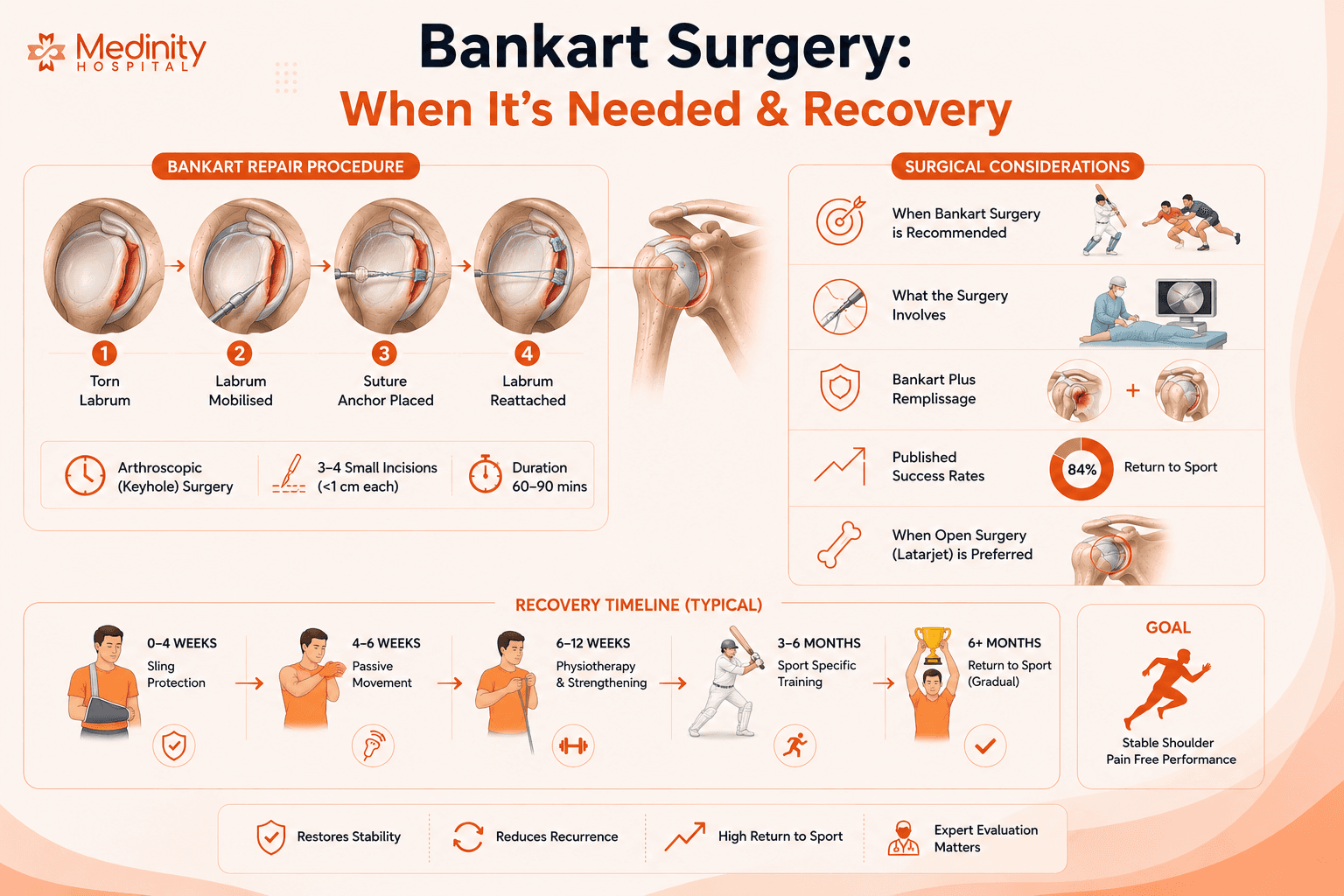
Bankart surgery is the primary surgical treatment for recurrent anterior shoulder instability in athletes. It involves arthroscopically reattaching the torn labrum back to the glenoid (socket) rim using suture anchors, restoring the socket's natural bumper depth.
Conservative treatment versus Bankart surgery: which is right for you?
There is no single right answer for every patient — the decision depends on age, sport, recurrence history, and MRI findings. This comparison summarises the trade-offs Dr. R.P. Singh discusses with patients:
Recovery after Bankart surgery:
- Week 1 to 2: Arm in a sling. Ice and pain management. Grip exercises and elbow movements only. The repaired labrum must not be stressed.
- Week 3 to 6: Sling weaned off at 4 to 6 weeks. Pendulum exercises, gentle passive range of motion under physiotherapist guidance.
- Month 2 to 3: Active range of motion exercises. Strengthening begins with rotator cuff and scapular stabiliser work. Increasing activities of daily living.
- Month 4 to 5: Progressive sport-specific strengthening. Throwing mechanics training begins for cricketers. Return to non-contact practice.
- Month 6: Return to contact sport discussed with Dr. R.P. Singh. Most athletes return to full sport activity at 6 to 9 months. Thorough physiotherapy assessment of strength and stability before clearance.
Return to cricket bowling or overhead sport typically takes 6 to 9 months after Bankart repair. Throwing athletes require longer and more structured rehabilitation than non-throwing athletes. Rushing return to overhead sport before full labral healing and muscle recovery is the most common cause of re-dislocation after surgery.
Shoulder dislocation surgery cost in Lucknow
Patients understandably want clarity on cost before committing to a treatment path. Arthroscopic Bankart repair costs vary depending on the implants used (suture anchors), whether an additional procedure such as remplissage or Latarjet is needed, the hospital tier, and the consultation and diagnostic work-up involved. Most major health insurance policies in India cover Bankart surgery as a recognised orthopaedic procedure. Medinity Hospital provides a transparent, written cost estimate for your specific case before any surgical commitment — call +91 94540 99331 to discuss your situation and insurance coverage.
Real case: recovery after Bankart surgery
A 22-year-old club-level cricketer from Lucknow came to Medinity Hospital after his third shoulder dislocation in eighteen months, each one happening while fielding. MRI confirmed a Bankart lesion with an early Hill-Sachs lesion and no significant glenoid bone loss. Dr. R.P. Singh recommended arthroscopic Bankart repair rather than continuing with physiotherapy alone, given the recurrence pattern and his age. The patient followed the staged rehabilitation programme — sling for the first month, progressive range-of-motion and strengthening work through months two to four, and sport-specific throwing mechanics from month four — and returned to competitive fielding and batting at seven months, with no further instability at follow-up. (Details anonymised and shared with patient consent.)
Shoulder dislocation treatment at Medinity Hospital, Gomti Nagar, Lucknow
Dr. R.P. Singh treats shoulder dislocations and recurrent instability in athletes from across Lucknow, including players from Gomti Nagar, Indira Nagar, Aliganj, Jankipuram, Hazratganj, and Alambagh, as well as from Sitapur, Hardoi, Barabanki, Raebareli, and Kanpur. The typical pathway at Medinity Hospital is:
Emergency reduction
Prompt reduction under appropriate muscle relaxation or sedation in the emergency department. X-rays taken before and after.
Initial immobilisation
Arm placed in a sling for 2 to 4 weeks for the acute injury. Ice, pain management, and rest. (Learn about immobilisation in our frozen shoulder treatment post)
Imaging and assessment
MRI of the shoulder at Medinity's NABL-accredited diagnostics centre to assess the Bankart lesion, Hill-Sachs lesion, and any associated rotator cuff or bony injury.
Surgical decision
Bankart surgery is discussed for recurrent instability, young contact sport athletes, and patients with significant structural lesions. The Latarjet procedure is offered when significant glenoid bone loss is present.
Post-operative physiotherapy
Integrated physiotherapy and rehabilitation at Medinity. Stage-specific exercises from week 1 through return to sport at month 6 to 9.
Why athletes in Lucknow choose Medinity Hospital for shoulder dislocation
- Dr. R.P. Singh: MS Ortho (Gold Medalist), Fellowship Sports Injury and Joint Reconstruction, USA and Germany
- 20+ years of orthopaedic practice, 2,000+ surgeries performed
- Emergency shoulder reduction available 24/7 at Medinity Hospital, Gomti Nagar
- Arthroscopic Bankart repair and Bankart plus remplissage available
- MRI and pre-operative bone loss assessment at NABL-accredited diagnostics centre
- Integrated physiotherapy from day 1 through return to sport
- NABH-accredited hospital | 4.8 stars | 246+ verified reviews
- Serving cricketers, kabaddi players, gym-goers from Lucknow, Sitapur, Hardoi, Barabanki, Raebareli, Kanpur and across UP
Consultation
Shoulder dislocation in Lucknow? Book an assessment at Medinity Hospital.
Whether this is your first dislocation or you have been dealing with a shoulder that keeps coming out, Dr. R.P. Singh at Medinity Hospital, Gomti Nagar, Lucknow, will assess the damage accurately, give you an honest recommendation on surgery versus rehabilitation, and support your return to the sport you play. Emergency care and planned surgical assessment both available.
- Emergency orthopaedic care 24/7
- Consultations 6 days a week
- Walk-in OPD available
CP-221, Hahnemann Medinity Hospital Road, Gomti Nagar, Lucknow 226010 · Walk-in OPD · 24/7 emergency
Help centre
Frequently asked questions
Apply a sling to support the arm against the body. Apply ice wrapped in cloth to the front of the shoulder. Call Medinity Hospital on +91 94540 99331 or go directly to the emergency department at Gomti Nagar, Lucknow. The shoulder must be reduced (relocated) by an orthopaedic doctor under muscle relaxation. Do not allow anyone without medical training to attempt relocation. Do not apply heat. Do not resume playing.
Without any medication, shoulder relocation is extremely painful. At Medinity Hospital, muscle relaxants and sedative medication are given before reduction to allow the muscles to relax, which is what allows the ball to slide back into the socket with gentle controlled technique. With appropriate medication, modern reduction techniques such as the Cunningham or FARES technique are significantly more comfortable than older forceful methods. Most patients are surprised by how manageable the procedure is when proper muscle relaxation is achieved.
This depends significantly on your age. Athletes under 20 have a recurrence rate exceeding 80% after a first dislocation without surgery. Between 20 and 30 years old, the recurrence risk is 50 to 70%. After 40, recurrence is less common but rotator cuff tear risk increases significantly. Dr. R.P. Singh at Medinity Hospital will assess your age, sport, MRI findings, and activity level before recommending whether surgery is appropriate after a first dislocation or whether physiotherapy rehabilitation should be tried first.
A Bankart lesion is a tear of the labrum at the front of the shoulder socket (glenoid). The labrum is the ring of cartilage that deepens the socket and holds the ball in place. When the shoulder dislocates anteriorly, the ball tears the labrum from the socket rim as it exits. The torn labrum does not heal back in the correct position without surgery. This is why the shoulder remains prone to re-dislocation without Bankart repair.
Bankart repair arthroscopically reattaches the torn labrum back to the glenoid rim. It is the preferred surgery when the glenoid bone and labral tissue are of adequate quality. The Latarjet procedure transfers a piece of bone (the coracoid process) to the front of the glenoid socket, recreating both the bumper depth and adding the conjoint tendon as a sling effect. Latarjet is preferred when significant glenoid bone loss (more than 20 to 25% of the socket) is present, because Bankart repair fails at very high rates in this situation. The choice between the two procedures depends on MRI and CT findings that Dr. R.P. Singh reviews at pre-operative assessment.
Published evidence shows: return to sport in 84% of patients across mid-to-long-term follow-up studies PMC systematic review 2023. In a 10-year follow-up study, 97.6% of patients returned to sport PMC 2025. When Bankart repair is combined with remplissage for patients who also have a significant Hill-Sachs lesion, the recurrence rate reduces to 12% at 81.4 months compared to 22 to 31% for isolated Bankart repair PMC 2025. Results are better when surgery is performed after a shorter interval from the first dislocation.
Most cricketers who are fielders can return to non-contact fielding practice at 4 to 5 months. Bowlers who need to achieve full overhead shoulder rotation require 6 to 9 months. Return to contact sport and full match play is typically cleared at 6 to 9 months. Rushing return to bowling before full labral healing and muscle recovery is the most common cause of failed Bankart repair. Dr. R.P. Singh uses specific strength testing and range of motion criteria before clearance, not a fixed calendar date.
For older patients, non-contact athletes, and those with a first-time dislocation who are willing to accept the recurrence risk, non-surgical rehabilitation is a reasonable option. Physiotherapy focusing on rotator cuff strengthening and shoulder stability can reduce (but not eliminate) recurrence risk. However, for young athletes under 25 in contact sports, non-surgical management has very high failure rates, and most sports orthopaedic specialists now recommend surgical discussion even after a first dislocation.
Cricket has specific mechanisms that make shoulder dislocation common. Fielders diving to save runs land on an outstretched arm with the shoulder forced outward, which is the classic anterior dislocation mechanism. Wicketkeepers and fielders in awkward catching positions are particularly at risk. Bowlers also stress the labrum with the repetitive overhead throwing motion. In Lucknow, where cricket is played intensively across all age groups, Dr. R.P. Singh regularly treats cricket-related shoulder dislocations from club and school players across Gomti Nagar, Indira Nagar, and surrounding areas.
A Hill-Sachs lesion is a dent or indentation in the back of the humeral head (the ball) that occurs when the ball strikes the front edge of the socket (glenoid) during a dislocation. It is present in approximately 40% of first-time dislocations and up to 90% of recurrent dislocations. When the Hill-Sachs dent is large enough to engage the front edge of the socket during normal arm movements, it contributes to re-dislocation even after Bankart repair. In this case, the remplissage procedure is added to Bankart surgery to fill the dent with tendon and prevent it from engaging.
Yes. Anterior shoulder dislocation is clearly visible on a standard AP (front-to-back) X-ray of the shoulder. The humeral head is seen displaced forward and downward, out of the glenoid socket. However, posterior dislocation is frequently missed on AP X-ray alone and requires additional views (axillary view and scapular Y-view) to be properly assessed. Any patient with a suspected shoulder dislocation at Medinity Hospital receives both standard and additional view X-rays to ensure neither anterior nor posterior dislocation is missed.
An unreduced shoulder dislocation is intensely painful and causes progressive damage to the surrounding muscles, nerves, and blood vessels. Delayed reduction, beyond 6 to 12 hours, is significantly more difficult and carries a higher risk of complications. A dislocation that is 'self-managed' or managed by untrained persons who attempt forceful reduction risks fracturing the humeral head, damaging the axillary nerve (which can cause permanent loss of deltoid muscle function), and tearing the rotator cuff. Every shoulder dislocation needs emergency orthopaedic assessment.
The most important prevention strategy is either surgical stabilisation (Bankart repair) for high-risk young athletes in contact sports, or a comprehensive shoulder strengthening programme for lower-risk patients. Rotator cuff and scapular stabiliser strengthening, proprioceptive training, and sport-specific rehabilitation supervised by a physiotherapist significantly reduce recurrence risk in patients managed non-surgically. A specific return-to-sport programme, with functional criteria rather than calendar dates, is used at Medinity Hospital before return to play is cleared.
Arthroscopic Bankart repair costs vary depending on the implants used (suture anchors), the hospital tier, and whether additional procedures such as remplissage are needed. Most major health insurance policies in India cover Bankart surgery as a recognised orthopaedic surgical procedure. Medinity Hospital provides a transparent, written cost estimate before any surgical commitment. Call +91 94540 99331 to discuss your specific case and insurance situation.
Yes, but with care. In the first one to two weeks, most patients find it easiest to sleep in a semi-reclined position (propped up with pillows, or in a recliner) with the arm supported in the sling, rather than flat on the back or on the affected side. Sleeping directly on the injured shoulder should be avoided until pain and swelling settle and Dr. R.P. Singh has assessed healing progress.
No. The joint itself will not ‘heal back into place’ on its own — it must be reduced (relocated) by a trained doctor. What can sometimes be managed without surgery afterward is the underlying instability: some patients, particularly older or lower-risk ones, recover reasonable stability through physiotherapy alone. But leaving a dislocation unreduced, or skipping medical assessment entirely, risks serious and sometimes permanent complications.
An X-ray is always needed immediately, to confirm the dislocation and rule out a fracture. An MRI is usually recommended afterward, especially for athletes and younger patients, because it shows the Bankart lesion, Hill-Sachs lesion, and any rotator cuff involvement that an X-ray cannot detect — information that directly affects whether surgery is recommended.
Yes. Exercises that place the shoulder in an extreme, loaded, externally rotated position — such as certain heavy overhead presses, wide-grip bench press, or behind-the-neck lifts — can dislocate an already unstable shoulder, and in rare cases cause a first-time dislocation in a shoulder with underlying looseness. Patients with a prior dislocation should have their gym programme reviewed by a physiotherapist before resuming overhead lifting.
Yes. The axillary nerve, which controls the deltoid muscle and sensation over the shoulder, runs close to the joint and is the nerve most commonly stretched or injured during an anterior dislocation, particularly in older patients. This is one of the reasons a neurovascular assessment, checking arm sensation, movement, and pulses, is a standard part of diagnosis both before and after reduction.
Shoulder dislocation is less common in children than in adolescents and young adults because growth plates tend to give way before the joint dislocates. However, it does occur, particularly in teenage athletes, and carries a very high recurrence risk given how many years of sport and joint use remain ahead. Any suspected shoulder dislocation in a child or teenager needs prompt orthopaedic assessment.
As with any surgery, there is discomfort during the initial recovery period, but it is well controlled with a combination of nerve blocks placed during surgery, oral pain medication, and ice. Most patients describe the first two to three days as the most uncomfortable, with pain reducing steadily as the sling and physiotherapy programme progress. Discomfort during rehabilitation exercises is normal and expected; sudden sharp pain should be reported to the surgical team.
About the author
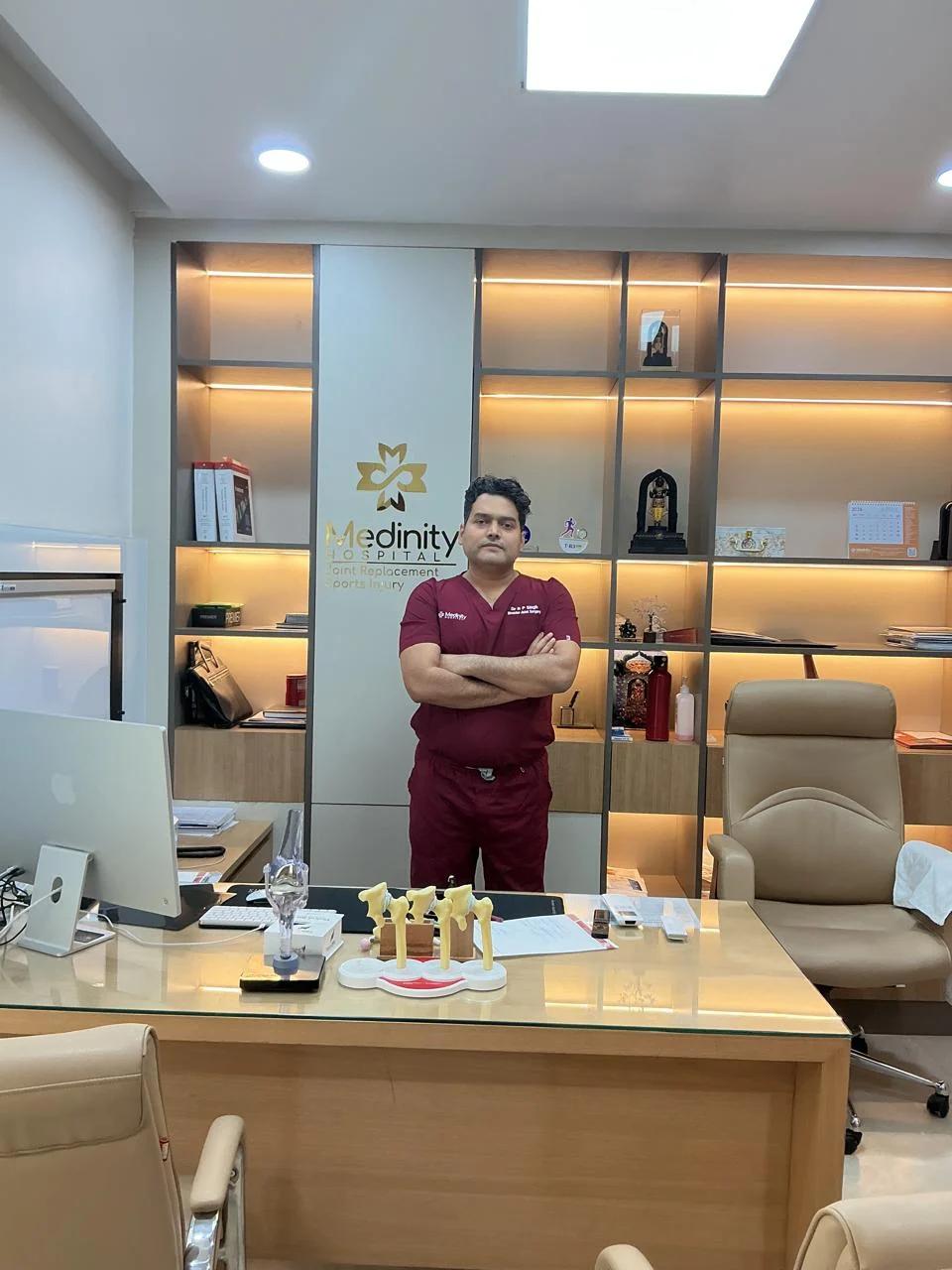
Dr. R.P. Singh
MS Ortho (Gold Medalist) · Fellowship Joint Reconstruction (USA, Germany) · Senior Orthopaedic Surgeon
- 20+ years experience
- 2,000+ surgeries
- Arthroscopic surgery expert
Dr. R.P. Singh is a Gold Medalist orthopaedic surgeon with over 20 years of experience. He specialises in arthroscopic ligament repairs (ACL, meniscus, shoulder instability) and joint replacement surgery, bringing advanced international techniques to athletes in Lucknow.
View full profile & credentials