
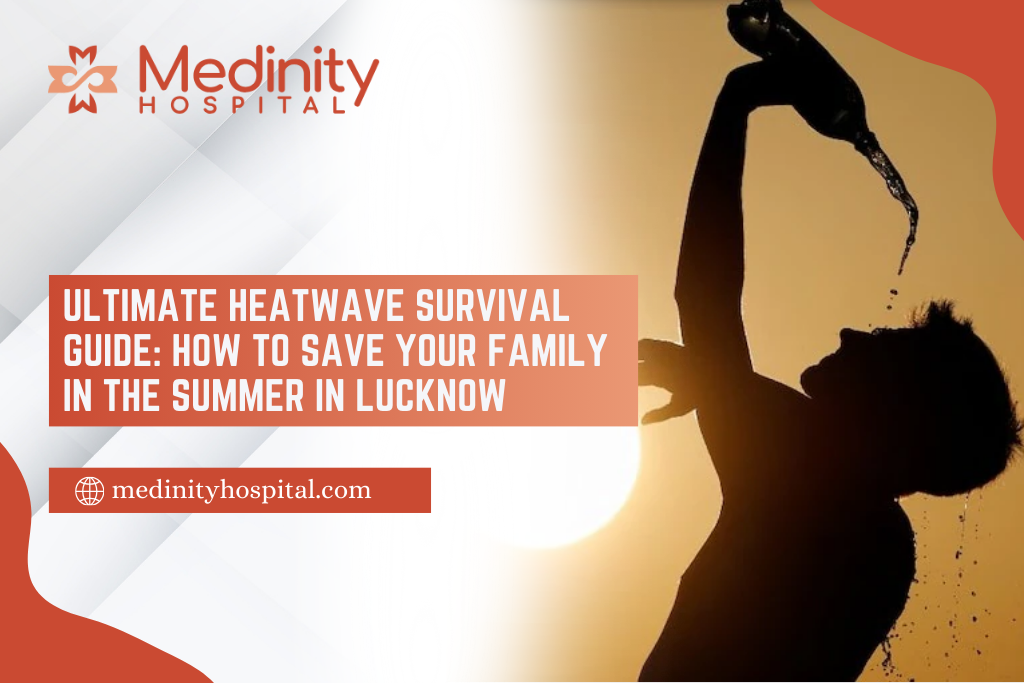
This is because the City of Nawabs is dramatically changing as the calendar shifts to May and June. The good spring breeze has taken the place of the scorching dry west wind–the Loo of the North Indian summer. The season is not merely a season of inconvenience to the people of Lucknow but a major health problem. In our Medinity Hospital, heat emergencies have increased tremendously these months, with mild cases of dehydration issues to life-threatening heatstroke. Learning how to manoeuvre these excessive temperatures is not merely a matter of comfort; it is also a matter of the health and safety of your loved ones.
Lucknow Heat Profile Knowledge
The summer season in Lucknow is extremely hot with large UV indices. By 2026, it is expected that there will be regular instances where temperatures exceed 40 degree celsius, with the highest intensity evident between 12:00 PM and 4:00 PM. Lucknow is dry, unlike the coastal cities, and therefore can dry your body water at an extremely fast rate, much faster than you are even aware of, whether you are sweating or not. It is this invisible water loss that causes the phenomenon of dehydration to be very deceptive. The physical topography of contemporary Lucknow also forms heat islands; urban areas in Lucknow are much hotter than their surrounding outskirts, which leads to further stress on the cooling system of the human body.
Hydration: Not a Simple Case of Drinking Water
During the time of sunshine, it is not necessary to drink much water when you feel thirsty. Thirst is, in fact, a late indicator of dehydration. You should rehydrate in advance in order to keep up with the heat. We suggest the so-called structured hydration method: drink two glasses of room-temperature water in the morning. During the day, add plain water with the Indian traditional coolers such as Chaas (buttermilk), Aam Panna and Nariyal Pani (coconut water). These beverages contain important electrolytes such as sodium, potassium and magnesium that are lost in the sweat.
Avoid caffeine in large amounts, sodas which contain high amounts of sugar and alcohol, which are also diuretics and, in fact, tend to increase fluid loss. One of the simplest techniques to keep check on your hydration level is by simply checking the colour of your urine; it should be a clear, light yellow, or a straw yellow. When it is dark, you have already moved into the danger zone.
Smarter Nutrition to Cool Introduced
During the May heat, the digestive system or the Agni, is prone to weakness. High amounts of metabolic energy are needed to digest heavy, oily, and high-protein meals, and this consequently raises the body’s internal temperature. Change to a more summer-friendly nutrition with more water-based products of the season. Consume a lot of cucumbers, watermelons, muskmelons and gourds (Lauki and Torai) in your food.
Yoghurt and curd are also good additions since they contain probiotics, which help to stabilise the gut against infections that are associated with summer. Frequent and small meals would be far more favourable to the system than three heavy meals. Also, natural cooling effect spices such as fennel (Saunf) and mint (Pudina) can be readily incorporated into your drinking water or salads to enable you control your internal thermostat.
Safeguarding the Weak: The Children and the Elderly
Here in Medinity Hospital, we stress the fact that not all people are equally sensitive to extreme heat. Children below five and the elderly aged above 65 are the most endangered. The surface to mass ratio of children is greater, which implies that they get hot much quicker than adults, and are not yet fully covered by sweat glands. Make sure that they are indoors and play when the time is most appropriate, and use light clothes made out of breathable and light colored cotton.
In the case of the elderly and patients who have already developed pre-existing conditions such as hypertension or diabetes, the heart will have to strain more to pump blood to the skin to cool it down. This may result in heart stress. Their symptoms should be monitored on a daily basis. Red flag symptoms include the onset of symptoms that are out of place, such as when a family member is otherwise lethargic, presents no sweat despite the heat, and so on. These are red flag symptoms and need urgent medical care.
Being aware of the Warning Signs: When to Seek Help
There is a need to differentiate between Heat Exhaustion and Heatstroke. Heat exhaustion is the cry of your body–this is manifested through excessive sweating, elevated pulse, dizziness and nausea. When this happens, then take that individual to a cool and shady place and undress him or her, and wet towels should be placed over the neck and armpits.
Heatstroke is howeve,r a medical emergency. It occurs when the body temperatures increase to over 40 °C. The skin would be hot, dry, and the affected individual could have seizures or become unconscious. Each minute matters in such situations. As the patient waits to get medical assistance or be transported to the Medinity Hospital, keep cooling him down using ice packs or a cool water spray.
Novelty Ideas of a Cooler Home
You do not necessarily have to have the air conditioner operating at full blast in order to make your house safe. Apply the “Day-Time Lockout” technique: seal all the windows, curtains, and the blinds on the side of the house that is facing the sun by 9: 00 AM to seal into the house the cooler morning air. Block the direct glare with the use of khus (vetiver) mats or heavy curtains. When using a desert cooler, make sure that there is a lot of air flowing in the room (a window that is slightly open) so that the humidity does not accumulate, and thus, prevents you from sweating. During the night, open the windows to get cross-ventilation that will allow the fresh night air to pass through.
The Lucknow summer is tough, yet it can be handled with the appropriate precautions. With the focus on hydration, diet changes, and a close observation of the most vulnerable individuals in your family, you will have a comfortable and healthy season.